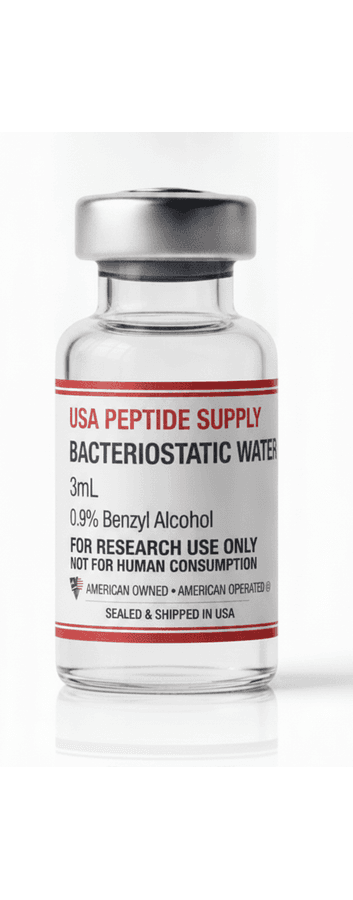
Bacteriostatic Water
Bacteriostatic water is sterile, non-pyrogenic water containing 0.9% benzyl alcohol as a bacteriostatic agent. It is the standard solvent used to reconstitute lyophilized peptides and prepare dilution series for in-vitro laboratory work.
The lab-bench solvent every lyophilized-peptide reconstitution starts with.
What it is
Bacteriostatic water is sterile, non-pyrogenic water (CAS 7732-18-5) containing 0.9% benzyl alcohol (CAS 100-51-6) as a bacteriostatic preservative. The benzyl alcohol inhibits microbial growth in vitro, so a sealed vial can be accessed multiple times under proper laboratory handling.
In the laboratory it is the standard solvent for reconstituting lyophilized peptides and preparing dilution series. Built from USP-grade components and supplied strictly for research use.
Reconstitution & storage
- Store sealed vials at room temperature, away from direct light.
- Once the stopper is punctured, keep refrigerated at 2-8C and use within the multi-use window.
- Do not use if the solution is cloudy or the seal is compromised; keep the vial upright.
Cited research applications
Questions
Compound identifiers & literature
Public database identifiers and a selection of peer-reviewed publications for Bacteriostatic Water, provided so researchers can verify this compound independently. Each entry links to the primary source.
Selected literature
- [1]Gershanik J, Boecler B, Ensley H, McCloskey S, George W (1982). The gasping syndrome and benzyl alcohol poisoning New England Journal of Medicine 307(22):1384-8.This report associated a fatal syndrome in premature infants with benzyl alcohol used as a preservative in catheter flush solutions. Note: the PubMed record carries no abstract and is indexed only as Journal Article, so the design label above is descriptive rather than an indexed publication type, and the specific clinical findings could not be read from the primary record in this pass.
- [2]Karabit MS, Juneskans OT, Lundgren P (1986). Studies on the evaluation of preservative efficacy--II. The determination of antimicrobial characteristics of benzylalcohol Journal of Clinical and Hospital Pharmacy 11(4):281-9.A kinetic in vitro study used D-value, activation energy, temperature coefficient and concentration exponent as parameters to characterise benzyl alcohol as a preservative, investigating the influence of solution pH, temperature and preservative concentration against five micro-organisms: Aspergillus niger, Candida albicans, Escherichia coli, Pseudomonas aeruginosa and Staphylococcus aureus.in vitroPMID 3531242
- [3]McCloskey SE, Gershanik JJ, Lertora JJ, White L, George WJ (1986). Toxicity of benzyl alcohol in adult and neonatal mice Journal of Pharmaceutical Sciences 75(7):702-5.Benzyl alcohol was administered intraperitoneally to adult and neonatal CD-1 male mice and gross behavioural changes were monitored. The LD50 at 4 hours was reported as 1000 mg/kg in both age groups, and mortality observed in adults over the following 7 days gave a day-7 LD50 of 650 mg/kg. Plasma benzyl alcohol and benzaldehyde levels were comparable between age groups, and enzyme-inhibition experiments with pyrazole and disulfiram led the authors to attribute acute toxicity to the parent alcohol rather than to benzaldehyde.
- [4]Minogue SC, Sun DA (2005). Bacteriostatic saline containing benzyl alcohol decreases the pain associated with the injection of propofol Anesthesia and Analgesia 100(3):683-686.This randomized trial in 120 adults undergoing propofol induction compared three allocations: a bacteriostatic saline preinjection, propofol premixed with lidocaine, and no pretreatment. It measured the incidence of reported injection pain. The study concerns bacteriostatic saline, a different formulation from Bacteriostatic Water for Injection. The abstract does not state the blinding method, although the record is MeSH-indexed under Double-Blind Method.human clinical trial (randomized, 120 adults; 39 bacteriostatic saline / 39 control / 42 lidocaine)PMID 15728052DOI
- [5]Ganter-Ritz V, Speroni KG, Atherton M (2012). A randomized double-blind study comparing intradermal anesthetic tolerability, efficacy, and cost-effectiveness of lidocaine, buffered lidocaine, and bacteriostatic normal saline for peripheral intravenous insertion Journal of Infusion Nursing 35(2):93-9.This randomized double-blind study in 256 surgical patients compared intradermal 1% lidocaine, buffered 1% lidocaine, and bacteriostatic normal saline containing benzyl alcohol on tolerability, efficacy and cost measures during peripheral intravenous catheter insertion. The study concerns bacteriostatic normal saline, a different formulation from Bacteriostatic Water for Injection.
These references are provided for scientific context only. They describe published research on this compound and are not evidence of safety or efficacy, not an endorsement of any use, and not medical advice. This product is supplied for laboratory research use only — not for human or animal consumption.
Related compounds
For Research Use Only. Not for human or animal consumption. This product has not been evaluated by the Food and Drug Administration. Not intended to diagnose, treat, cure, or prevent any disease. Bacteriostatic Water is sold strictly as a research chemical for in-vitro and pre-clinical laboratory investigation only.