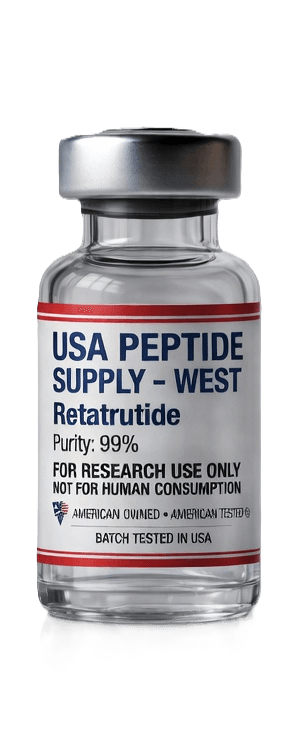
Retatrutide
Retatrutide is a synthetic 39-residue peptide engineered to co-activate the GLP-1, GIP, and glucagon receptors, with C20 fatty-diacid acylation for extended plasma stability. It is a reference compound in pre-clinical incretin and metabolic-signaling research.
A benchmark tool compound for poly-agonist incretin pharmacology.
What it is
Retatrutide is a 39-amino-acid synthetic peptide engineered to co-activate the GLP-1, GIP, and glucagon receptors. A C20 fatty-diacid moiety promotes albumin binding and a long plasma half-life.
It is used as a reference compound in pre-clinical incretin pharmacology to benchmark single- versus poly-receptor response curves. For laboratory research only.
Reconstitution & storage
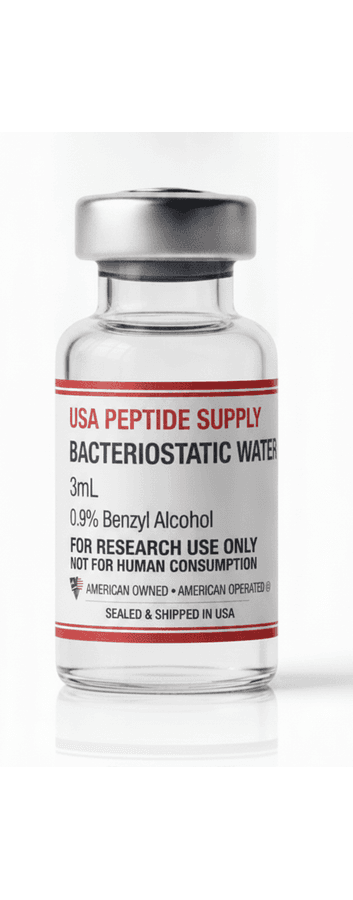
- Reconstitute with bacteriostatic water — add slowly down the vial wall and swirl gently; do not shake.
- Store lyophilized vials at -20°C; once reconstituted keep at 2–8°C and use within 16 weeks.
- Protect from light and avoid repeated freeze–thaw cycles.
Cited research applications
Questions
Compound identifiers & literature
Public database identifiers and a selection of peer-reviewed publications for Retatrutide (LY3437943), provided so researchers can verify this compound independently. Each entry links to the primary source.
Selected literature
- [1]Coskun T, et al. (2022). LY3437943, a novel triple glucagon, GIP, and GLP-1 receptor agonist for glycemic control and weight loss: From discovery to clinical proof of concept Cell Metabolism.This report characterises LY3437943 across in vitro receptor-activity assays at the glucagon, GIP and GLP-1 receptors, studies in obese mice measuring body weight and glycaemic parameters, and a phase 1 single-ascending-dose study in humans assessing safety, tolerability and pharmacokinetics, with observations extending to day 43 after a single dose.
- [2]Urva S, et al. (2022). LY3437943, a novel triple GIP, GLP-1, and glucagon receptor agonist in people with type 2 diabetes: a phase 1b, multicentre, double-blind, placebo-controlled, randomised, multiple-ascending dose trial The Lancet.A 12-week phase 1b double-blind, placebo-controlled, randomised multiple-ascending-dose trial in adults with type 2 diabetes, in which 72 participants received at least one dose across LY3437943, placebo and dulaglutide arms. Safety and tolerability were the primary objective, with pharmacokinetic and pharmacodynamic measures including plasma glucose, HbA1c and body weight as secondary measures.
- [3]Jastreboff AM, et al. (2023). Triple-Hormone-Receptor Agonist Retatrutide for Obesity - A Phase 2 Trial New England Journal of Medicine.A phase 2 randomised, double-blind, placebo-controlled trial in 338 adults with obesity, comparing ascending retatrutide dose groups with placebo over a 48-week treatment period. The primary endpoint was percentage change in body weight from baseline to 24 weeks; safety and tolerability were also assessed.
- [4]Rosenstock J, et al. (2023). Retatrutide, a GIP, GLP-1 and glucagon receptor agonist, for people with type 2 diabetes: a randomised, double-blind, placebo and active-controlled, parallel-group, phase 2 trial conducted in the USA The Lancet.A phase 2 randomised, double-blind, placebo- and active-controlled parallel-group trial conducted at 42 research and health-care centres in the USA in people with type 2 diabetes, with 281 participants randomly assigned. Dulaglutide 1.5 mg served as the active comparator. Treatment ran 36 weeks, with change in HbA1c from baseline to 24 weeks as the primary endpoint.
- [5]Sanyal AJ, et al. (2024). Triple hormone receptor agonist retatrutide for metabolic dysfunction-associated steatotic liver disease: a randomized phase 2a trial Nature Medicine.A phase 2a randomised, double-blind, placebo-controlled trial in 98 participants with metabolic dysfunction-associated steatotic liver disease and at least 10% liver fat at baseline, receiving 48 weeks of once-weekly retatrutide or placebo. The stated endpoint was mean relative change from baseline in liver fat at 24 weeks, measured by imaging.
These references are provided for scientific context only. They describe published research on this compound and are not evidence of safety or efficacy, not an endorsement of any use, and not medical advice. This product is supplied for laboratory research use only — not for human or animal consumption.
Related compounds
For Research Use Only. Not for human or animal consumption. This product has not been evaluated by the Food and Drug Administration. Not intended to diagnose, treat, cure, or prevent any disease. Retatrutide is sold strictly as a research chemical for in-vitro and pre-clinical laboratory investigation only.