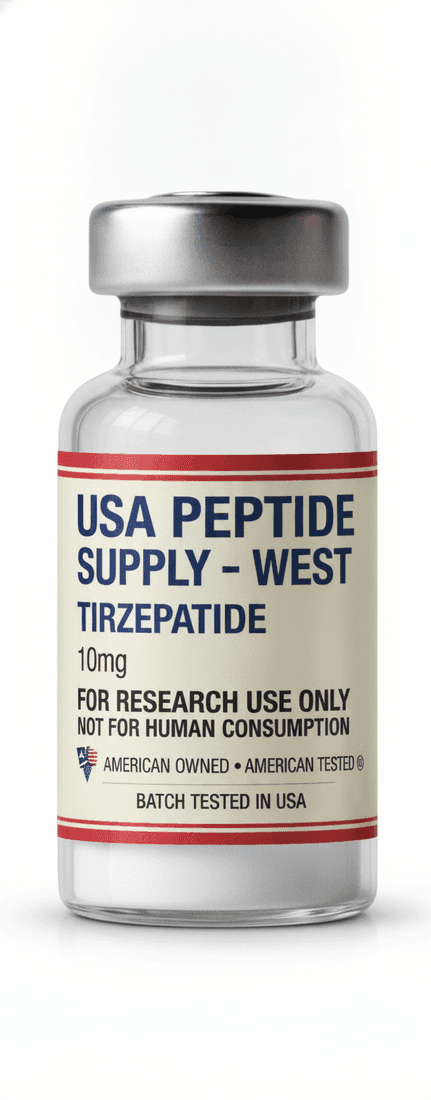
Tirzepatide
Tirzepatide is a synthetic 39-residue peptide engineered to co-activate the GIP and GLP-1 receptors, with C20 fatty-diacid acylation for an extended pharmacokinetic profile. It is a reference compound in dual-incretin signaling research.
A benchmark dual-incretin reference compound for receptor-signaling studies.
What it is
Tirzepatide is a 39-amino-acid chimeric peptide that activates both the GIP and GLP-1 receptors. A C20 fatty-diacid moiety supports albumin binding and an extended half-life.
It is used as a reference compound in pre-clinical dual-incretin signaling research, benchmarking single- versus dual-receptor activity. For laboratory use only.
Reconstitution & storage
- Reconstitute with bacteriostatic water — add slowly down the vial wall and swirl gently; do not shake.
- Store lyophilized vials at -20°C; once reconstituted keep at 2–8°C and use within 16 weeks.
- Protect from light and avoid repeated freeze–thaw cycles.
Cited research applications
Questions
Compound identifiers & literature
Public database identifiers and a selection of peer-reviewed publications for Tirzepatide, provided so researchers can verify this compound independently. Each entry links to the primary source.
Selected literature
- [1]Coskun T, Sloop KW, Loghin C, et al. (2018). LY3298176, a novel dual GIP and GLP-1 receptor agonist for the treatment of type 2 diabetes mellitus: From discovery to clinical proof of concept Molecular Metabolism.Reports the discovery and initial characterization of LY3298176 (tirzepatide), including cAMP signaling assays in engineered and primary human cells expressing GIP and GLP-1 receptors, studies in mouse models, and a phase 1 program in 142 human subjects comprising healthy volunteers and participants with type 2 diabetes.
- [2]Willard FS, Douros JD, Gabe MBN, et al. (2020). Tirzepatide is an imbalanced and biased dual GIP and GLP-1 receptor agonist JCI Insight.Characterizes tirzepatide's receptor pharmacology in HEK293 and CHO-K1 cell lines expressing GIP or GLP-1 receptors, in isolated mouse pancreatic islets, and in mice with beta-cell-targeted deletion of beta-arrestin1, reporting stronger engagement of the GIP receptor than the GLP-1 receptor and, at the GLP-1 receptor, signaling that favors cAMP generation over beta-arrestin recruitment.
- [3]Frías JP, et al. (2021). Tirzepatide versus Semaglutide Once Weekly in Patients with Type 2 Diabetes New England Journal of Medicine.A 40-week phase 3 randomized trial in 1,879 adults with type 2 diabetes, assigned 1:1:1:1 to tirzepatide 5, 10 or 15 mg or to once-weekly semaglutide 1 mg, with change in glycated hemoglobin from baseline to 40 weeks as the primary endpoint; the most common adverse events were gastrointestinal and were primarily mild to moderate in severity.
- [4]Jastreboff AM, et al. (2022). Tirzepatide Once Weekly for the Treatment of Obesity New England Journal of Medicine.A 72-week phase 3 randomized, placebo-controlled trial in 2,539 adults with a BMI of 30 or higher, or 27 or higher with a weight-related complication, excluding participants with diabetes; co-primary endpoints were percentage change in weight from baseline and a weight reduction of 5% or more across three tirzepatide dose levels, and the most common adverse events with tirzepatide were gastrointestinal, mostly mild to moderate, occurring primarily during dose escalation.
- [5]Malhotra A, et al. (2024). Tirzepatide for the Treatment of Obstructive Sleep Apnea and Obesity New England Journal of Medicine.Two phase 3 randomized, placebo-controlled trials over 52 weeks in adults with moderate-to-severe obstructive sleep apnea and obesity, assigned 1:1 to tirzepatide at a maximum tolerated dose of 10 or 15 mg or to placebo, with change from baseline in the apnea-hypopnea index as the primary endpoint; the most frequently reported adverse events with tirzepatide were gastrointestinal and mostly mild to moderate in severity.
These references are provided for scientific context only. They describe published research on this compound and are not evidence of safety or efficacy, not an endorsement of any use, and not medical advice. This product is supplied for laboratory research use only — not for human or animal consumption.
Related compounds
For Research Use Only. Not for human or animal consumption. This product has not been evaluated by the Food and Drug Administration. Not intended to diagnose, treat, cure, or prevent any disease. Tirzepatide is sold strictly as a research chemical for in-vitro and pre-clinical laboratory investigation only.