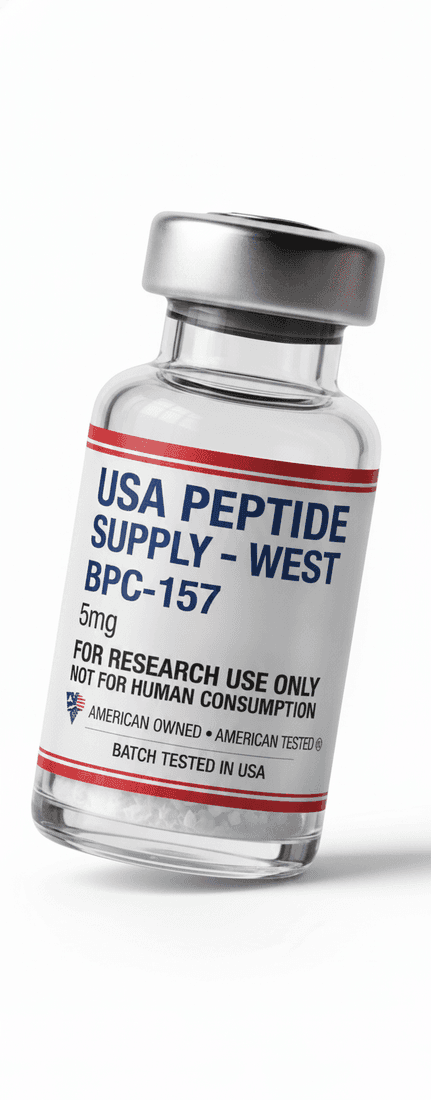
BPC-157
BPC-157 is a synthetic 15-residue peptide derived from a sequence in human gastric juice protein. It is among the most-referenced tool compounds in pre-clinical angiogenesis, fibroblast-migration, and gut-mucosa research, noted for stability in aqueous and acidic conditions.
The most-cited reference peptide in independent tissue-repair literature.
What it is
BPC-157 is a stable 15-amino-acid pentadecapeptide (Body Protection Compound) corresponding to a partial sequence of a protein found in gastric juice. Its stability in aqueous and acidic environments makes it a convenient laboratory reference standard.
Across pre-clinical and in-vitro literature it is used as a tool compound to probe angiogenic signaling, fibroblast migration, and extracellular-matrix interactions. Supplied strictly for laboratory research.
Reconstitution & storage
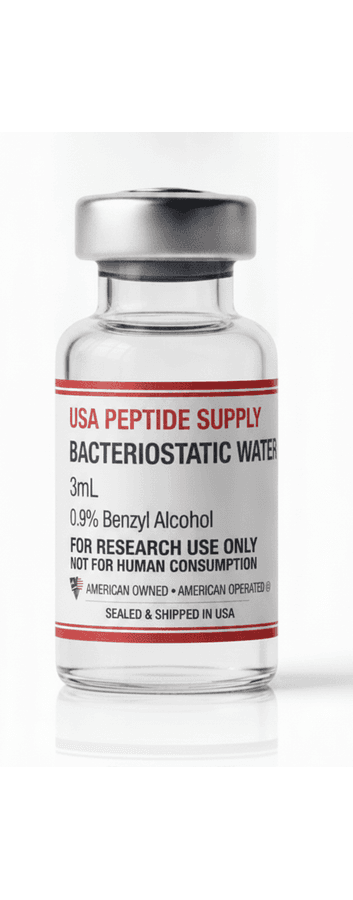
- Reconstitute with bacteriostatic water — add slowly down the vial wall and swirl gently; do not shake.
- Store lyophilized vials at -20°C; once reconstituted keep at 2–8°C and use within 16 weeks.
- Protect from light and avoid repeated freeze–thaw cycles.
Cited research applications
Questions
Compound identifiers & literature
Public database identifiers and a selection of peer-reviewed publications for BPC-157 (Body Protection Compound-157), provided so researchers can verify this compound independently. Each entry links to the primary source.
Selected literature
- [1]Vasireddi N, Hahamyan H, Salata MJ, Karns M, Calcei JG, Voos JE, Apostolakos JM (2025). Emerging Use of BPC-157 in Orthopaedic Sports Medicine: A Systematic Review HSS Journal.Systematic review that identified 544 articles published between 1993 and 2024 and included 36 studies of BPC-157 in musculoskeletal contexts, of which 35 were preclinical (animal or in vitro) and 1 was a retrospective human chart review; the authors record that preclinical safety studies reported no adverse effects across several organ systems, that no clinical safety data were found, and that adverse effects are possible due to unregulated manufacturing, contamination, or unknown clinical safety.
- [2]Gwyer D, Wragg NM, Wilson SL (2019). Gastric pentadecapeptide body protection compound BPC 157 and its role in accelerating musculoskeletal soft tissue healing Cell and Tissue Research.Narrative review of published tendon, ligament, and skeletal muscle injury studies involving BPC-157; the authors report that the studies they surveyed described positive healing effects, while stating that the majority of that literature was generated in small rodent models, that efficacy has not been confirmed in humans, and that the precise healing mechanisms are not yet understood.
- [3]Chang CH, Tsai WC, Lin MS, Hsu YH, Pang JH (2011). The promoting effect of pentadecapeptide BPC 157 on tendon healing involves tendon outgrowth, cell survival, and cell migration Journal of Applied Physiology (1985).In vitro and ex vivo study in which rat Achilles tendon explants and cultured rat tendon fibroblasts were exposed to BPC-157; the authors report accelerated explant outgrowth, increased cell survival under hydrogen peroxide stress, dose-dependent increases in fibroblast migration and spreading, and dose-dependent increases in FAK and paxillin phosphorylation, with no direct effect on cell proliferation by MTT assay. No live animals were treated in this study.
- [4]Japjec M, Horvat Pavlov K, Petrovic A, Staresinic M, Sebecic B, Buljan M, Vranes H, Giljanovic A, Drmic D, Prtoric A, Lovric E, Batelja Vuletic L, Dobric I, Boban Blagaic A, Skrtic A, Seiwerth S, Sikiric P (2021). Stable Gastric Pentadecapeptide BPC 157 as a Therapy for the Disable Myotendinous Junctions in Rats Biomedicines.Rat study in which the quadriceps tendon was surgically separated from the quadriceps muscle to create a myotendinous junction defect; BPC-157 was given intraperitoneally or orally at several doses and compared with controls using macroscopic, microscopic, biomechanical, and functional assessment plus eNOS and COX-2 mRNA levels and oxidative stress and nitric oxide measures, with observations reported at timepoints including 28 and 42 days.
- [5]Lee E, Padgett B (2021). Intra-Articular Injection of BPC 157 for Multiple Types of Knee Pain Alternative Therapies in Health and Medicine.Retrospective chart review at a single clinic covering 2019-2020, in which 17 patients received intra-articular knee injections of BPC-157 alone or combined with thymosin beta-4 and 16 were reached for a follow-up telephone survey; 14 of those 16 reported some relief of knee pain. There was no control group, follow-up timing varied between patients, and the authors state that no specific tools were used to measure improvement in function, quality of life, stiffness, or activities of daily living. This design cannot establish efficacy.human (retrospective, uncontrolled single-clinic chart review / case series — NOT a controlled clinical trial)PMID 34324435
These references are provided for scientific context only. They describe published research on this compound and are not evidence of safety or efficacy, not an endorsement of any use, and not medical advice. This product is supplied for laboratory research use only — not for human or animal consumption.
Related compounds
For Research Use Only. Not for human or animal consumption. This product has not been evaluated by the Food and Drug Administration. Not intended to diagnose, treat, cure, or prevent any disease. BPC-157 is sold strictly as a research chemical for in-vitro and pre-clinical laboratory investigation only.