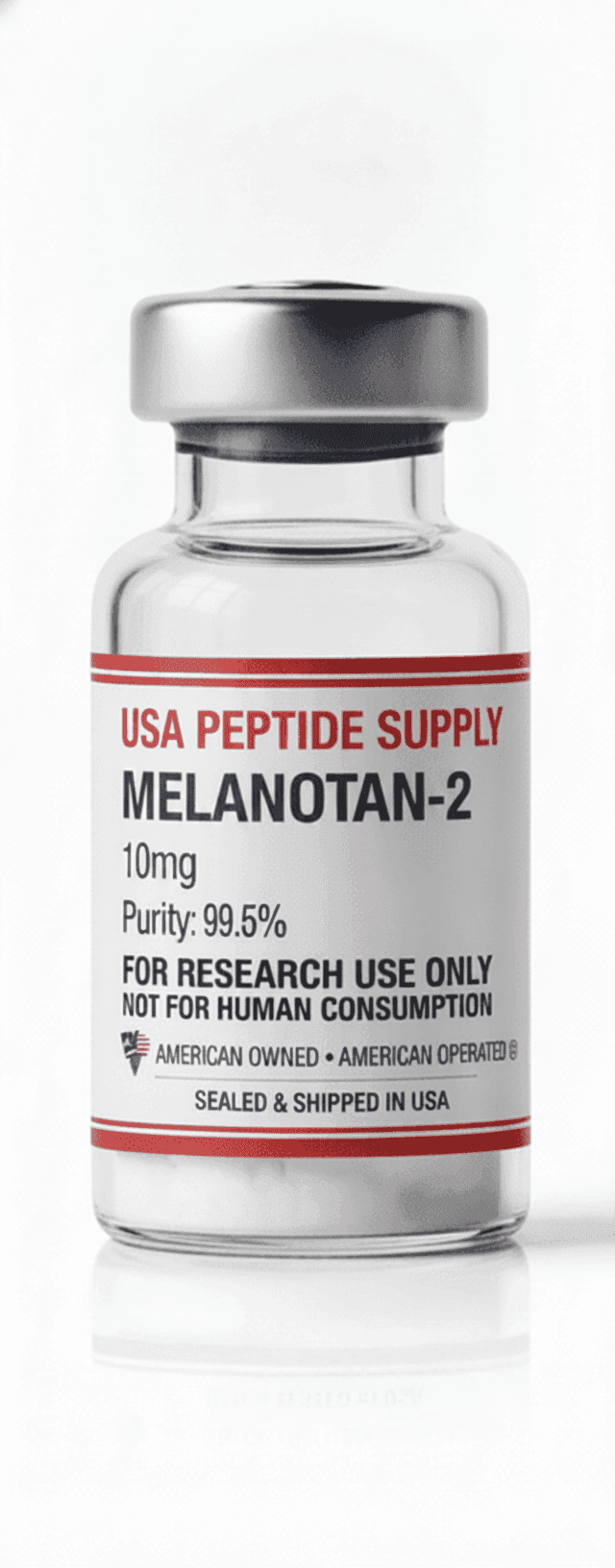
Melanotan-2
Melanocortin-receptor agonist for pigmentation research.
Compound identifiers & literature
Public database identifiers and a selection of peer-reviewed publications for Melanotan II, provided so researchers can verify this compound independently. Each entry links to the primary source.
Selected literature
- [1]Dorr RT, Lines R, Levine N, Brooks C, Xiang L, Hruby VJ, Hadley ME (1996). Evaluation of melanotan-II, a superpotent cyclic melanotropic peptide in a pilot phase-I clinical study Life Sciences 58(20):1777-1784.A single-blind, saline-controlled pilot phase I trial in three healthy male volunteers given subcutaneous melanotan-II on alternating weekdays over two weeks at 0.01 mg/kg escalating to 0.025-0.03 mg/kg, recording reflectance-measured pigmentation change and adverse effects including somnolence, fatigue, nausea and spontaneous erections.
- [2]Wessells H, Fuciarelli K, Hansen J, Hadley ME, Hruby VJ, Dorr R, Levine N (1998). Synthetic melanotropic peptide initiates erections in men with psychogenic erectile dysfunction: double-blind, placebo controlled crossover study The Journal of Urology 160(2):389-393.A double-blind, placebo-controlled crossover study in ten men with psychogenic erectile dysfunction that used RigiScan monitoring over a six-hour window and reported a longer mean duration of penile tip rigidity above 80% after subcutaneous melanotan-II (38 minutes) than after placebo (3 minutes), with nausea, yawning and decreased appetite reported more often on the peptide.human clinical trialPMID 9679884
- [3]Hadley ME, Dorr RT (2006). Melanocortin peptide therapeutics: historical milestones, clinical studies and commercialization Peptides 27(4):921-930.A review tracing the laboratory development, clinical investigation and commercialization history of melanocortin analogues, including melanotan-I and melanotan-II and the derivation of the later analogue PT-141 (bremelanotide) from melanotan-II.
- [4]Jain S, Panyutin A, Liu N, Xiao C, Pinol RA, Pundir P, Girardet C, Butler AA, Dong X, Gavrilova O, Reitman ML (2018). Melanotan II causes hypothermia in mice by activation of mast cells and stimulation of histamine 1 receptors American Journal of Physiology - Endocrinology and Metabolism 315(3):E357-E366.In mice, intraperitoneal melanotan-II produced transient hypometabolism and hypothermia that persisted in animals lacking melanocortin receptors 1, 3, 4 or 5 but was abolished in mast-cell-deficient KitW-sh/W-sh mice, and the authors attributed the effect to mast cell activation, raised plasma histamine and signalling through histamine H1 receptors.
- [5]Hjuler KF, Lorentzen HF (2014). Melanoma associated with the use of melanotan-II Dermatology 228(1):34-36.A single case report of a 20-year-old woman with Fitzpatrick skin type II whose excised gluteal lesion was confirmed histologically as melanoma approximately three months after a 3- to 4-week course of self-administered melanotan-II injections used alongside sunbed tanning; the authors describe the events as coinciding and note that the drug is unlicensed and incompletely tested, and a single case report establishes temporal association only, not causation.
These references are provided for scientific context only. They describe published research on this compound and are not evidence of safety or efficacy, not an endorsement of any use, and not medical advice. This product is supplied for laboratory research use only — not for human or animal consumption.
For Research Use Only. Not for human or animal consumption. This product has not been evaluated by the Food and Drug Administration. Not intended to diagnose, treat, cure, or prevent any disease. Melanotan-2 is sold strictly as a research chemical for in-vitro and pre-clinical laboratory investigation only.