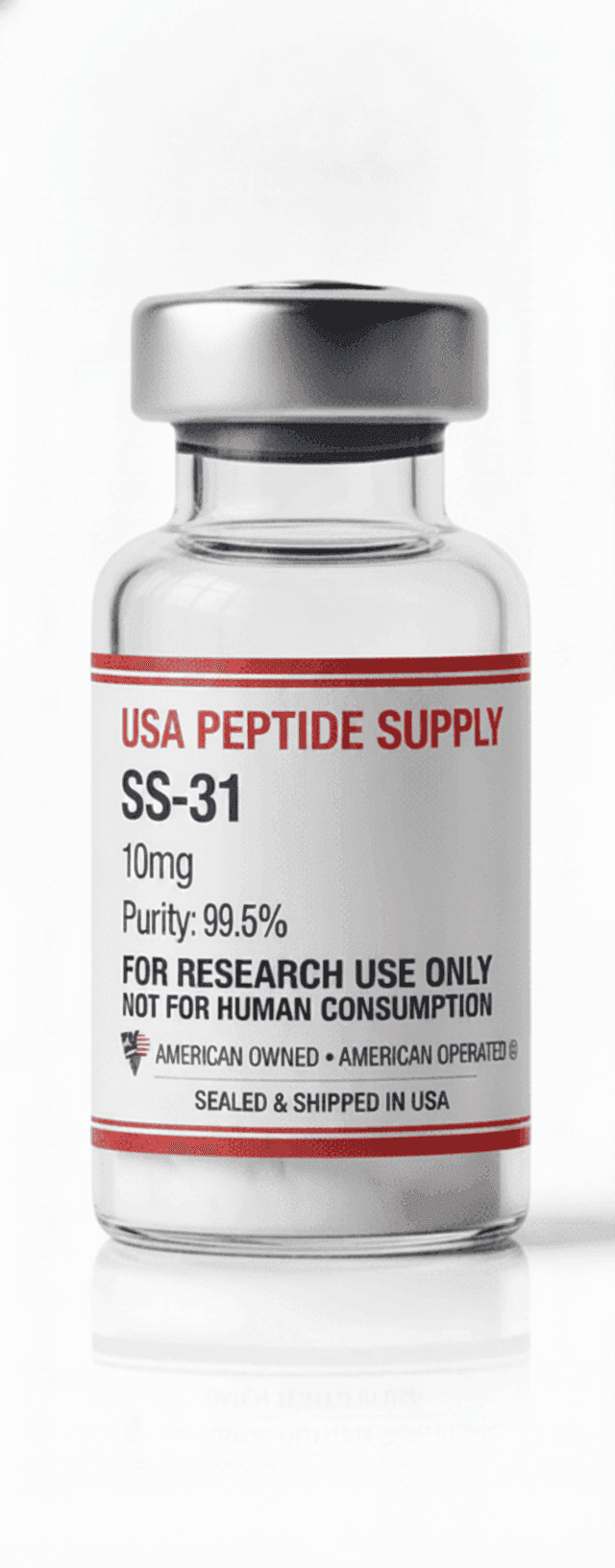
SS-31
Mitochondria-targeted peptide (elamipretide) for cellular-energy research.
Compound identifiers & literature
Public database identifiers and a selection of peer-reviewed publications for SS-31 (Elamipretide), provided so researchers can verify this compound independently. Each entry links to the primary source.
Selected literature
- [1]Chavez JD, Tang X, Campbell MD, Reyes G, Kramer PA, Stuppard R, Keller A, Zhang H, Rabinovitch PS, Marcinek DJ, Bruce JE (2020). Mitochondrial protein interaction landscape of SS-31 Proceedings of the National Academy of Sciences of the United States of America.Mitochondria were isolated from the hearts of four CB6F1 mice and treated with a biotinylated SS-31 analogue in vitro, with no animal receiving the compound, and chemical cross-linking with mass spectrometry identified twelve interacting cardiolipin-binding mitochondrial proteins whose cross-link sites localized near known cardiolipin-interaction regions, alongside oxygen consumption and hydrogen peroxide measurements in the isolated organelles.
- [2]Karaa A, Bertini E, Carelli V, Cohen BH, Enns GM, Falk MJ, Goldstein A, Gorman GS, Haas R, Hirano M, et al. (2023). Efficacy and Safety of Elamipretide in Individuals With Primary Mitochondrial Myopathy: The MMPOWER-3 Randomized Clinical Trial Neurology.In a 24-week randomized, double-blind, placebo-controlled phase 3 trial that randomized 218 adults with genetically confirmed primary mitochondrial myopathy 1:1 to subcutaneous elamipretide 40 mg/d or placebo, the trial did not meet either co-primary endpoint, reporting a between-group difference of -3.2 meters on the 6-minute walk test (95% CI -18.7 to 12.3; p=0.69) and -0.07 on the Primary Mitochondrial Myopathy Symptom Assessment total fatigue score (95% CI -0.10 to 0.26; p=0.37), with most adverse events mild to moderate.
- [3]Thompson WR, Hornby B, Vernon HJ, et al. (2024). Long-term efficacy and safety of elamipretide in patients with Barth syndrome: 168-week open-label extension results of TAZPOWER Genetics in Medicine.Following a 28-week randomized, double-blind, placebo-controlled phase, 10 patients with Barth syndrome entered an uncontrolled and unblinded open-label extension of daily subcutaneous elamipretide in which 8 completed the week 168 visit, and the authors reported a cumulative 96.1-meter change from extension baseline on the 6-minute walk test (p=0.003) together with changes in 3D left ventricular volumes and in the monolysocardiolipin to cardiolipin ratio, with injection-site reactions the most commonly reported adverse event; the extension itself had no placebo comparator, so its within-patient changes cannot be attributed to the compound.
- [4]Whitson JA, Martín-Pérez M, Zhang T, Gaffrey MJ, Merrihew GE, Huang E, White CC, Kavanagh TJ, Qian WJ, Campbell MD, MacCoss MJ, Marcinek DJ, Villén J, Rabinovitch PS (2021). Elamipretide (SS-31) treatment attenuates age-associated post-translational modifications of heart proteins GeroScience.Mass spectrometry profiling of heart tissue from young (5-6 month) and aged (24 month) mice compared post-translational modifications after 8 weeks of elamipretide treatment in the aged group, with the authors reporting that treatment reversed most of the age-associated increase in protein S-glutathionylation and partially shifted age-associated phosphorylation patterns in a site-dependent manner.
- [5]Obi C, Smith AT, Hughes GJ, Adeboye AA (2022). Targeting mitochondrial dysfunction with elamipretide Heart Failure Reviews.A narrative review summarizing the proposed cardiolipin- and cytochrome c-directed mechanism of elamipretide and collating preclinical canine and rat heart failure data alongside early-phase human findings, in which the authors state that long-term safety and effectiveness in clinical populations remain to be established.
These references are provided for scientific context only. They describe published research on this compound and are not evidence of safety or efficacy, not an endorsement of any use, and not medical advice. This product is supplied for laboratory research use only — not for human or animal consumption.
For Research Use Only. Not for human or animal consumption. This product has not been evaluated by the Food and Drug Administration. Not intended to diagnose, treat, cure, or prevent any disease. SS-31 is sold strictly as a research chemical for in-vitro and pre-clinical laboratory investigation only.