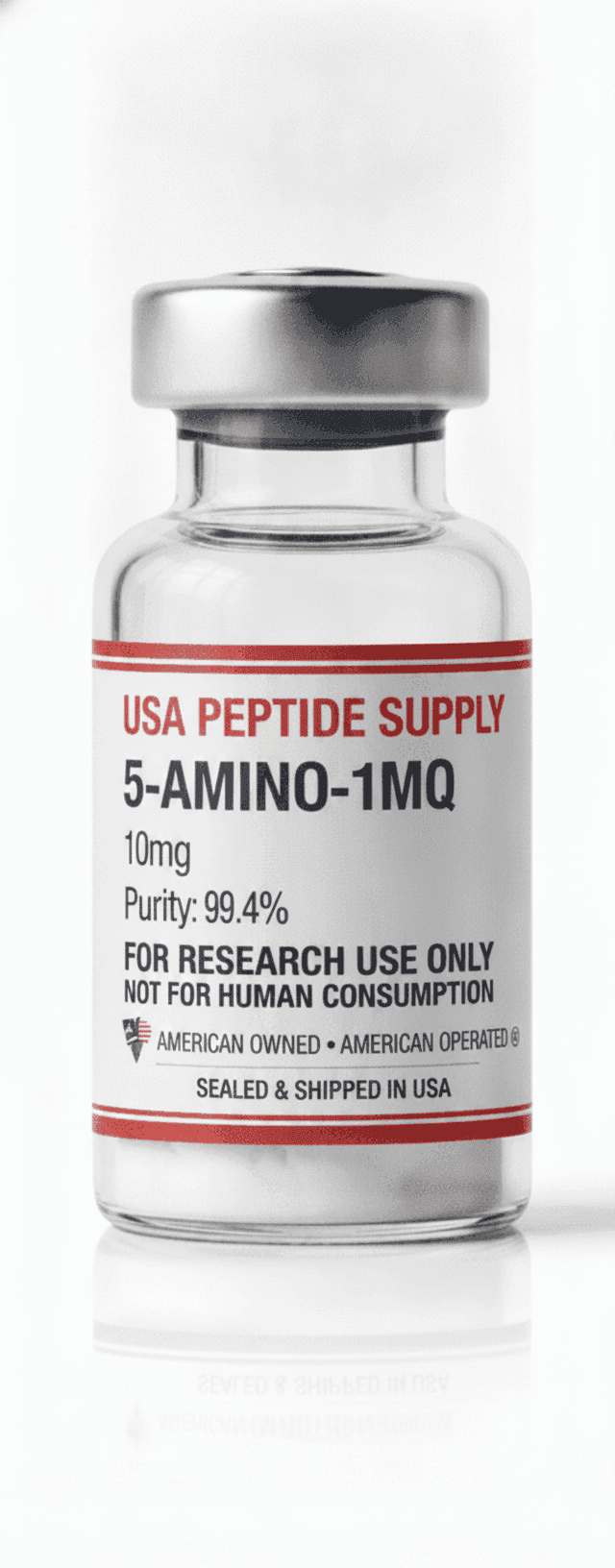
5-Amino-1MQ
Small-molecule NNMT inhibitor for metabolic and adipose research.
Compound identifiers & literature
Public database identifiers and a selection of peer-reviewed publications for 5-Amino-1MQ (5-amino-1-methylquinolinium), provided so researchers can verify this compound independently. Each entry links to the primary source.
Selected literature
- [1]Neelakantan H, Wang HY, Vance V, Hommel JD, McHardy SF, Watowich SJ (2017). Structure-Activity Relationship for Small Molecule Inhibitors of Nicotinamide N-Methyltransferase Journal of Medicinal Chemistry.Biochemical screening of N-methylated quinolinium, isoquinolinium, pyridinium and benzimidazolium/benzothiazolium analogues against nicotinamide N-methyltransferase, reporting a greater than 1000-fold activity range across the series and identifying the quinolinium scaffold as reaching approximately 1 micromolar IC50, with computational docking to the enzyme substrate-binding site correlated against measured IC50 values. This paper characterises the quinolinium inhibitor class to which 5-amino-1MQ belongs; the abstract does not name 5-amino-1MQ individually.
- [2]Neelakantan H, Vance V, Wetzel MD, Wang HL, McHardy SF, Finnerty CC, Hommel JD, Watowich SJ (2018). Selective and membrane-permeable small molecule inhibitors of nicotinamide N-methyltransferase reverse high fat diet-induced obesity in mice Biochemical Pharmacology.Administered 5-amino-1MQ to diet-induced obese male C57Bl/6 mice by subcutaneous injection at 20 mg/kg per injection, three injections per day for 11 days, measuring body weight, food intake, epididymal white adipose tissue mass, adipocyte size on histology and plasma total cholesterol. Dosing details are stated in the full text rather than the abstract.
- [3]Neelakantan H, Brightwell CR, Graber TG, Maroto R, Wang HL, McHardy SF, Papaconstantinou J, Fry CS, Watowich SJ (2019). Small molecule nicotinamide N-methyltransferase inhibitor activates senescent muscle stem cells and improves regenerative capacity of aged skeletal muscle Biochemical Pharmacology.Administered 5-amino-1-methylquinolinium at 5 and 10 mg/kg subcutaneously twice daily to 24-month-old male C57Bl/6 mice after barium chloride-induced tibialis anterior injury, with parallel experiments in cultured C2C12 myoblasts, measuring muscle stem cell proliferation and fusion by EdU labelling, myofiber cross-sectional area, dorsiflexor torque, NAD+/NADH ratios and serum chemistry panels. The abstract refers to the compound generically as an NNMT inhibitor; the chemical identity is stated in the full-text methods.
- [4]Sampson CM, Dimet AL, Neelakantan H, Ogunseye KO, Stevenson HL, Hommel JD, Watowich SJ (2021). Combined nicotinamide N-methyltransferase inhibition and reduced-calorie diet normalizes body composition and enhances metabolic benefits in obese mice Scientific Reports.Compared 5-amino-1-methylquinolinium alone against the same compound combined with a lean-diet substitution in male 18-week-old C57BL/6J diet-induced obese mice dosed by daily injection, measuring body weight, fat and lean mass, food intake, liver and epididymal white adipose tissue weights, hepatic steatosis scoring, serum chemistry and adipose tissue metabolomic profiles by GC-MS. The abstract refers to the compound generically as NNMTi; the chemical identity is stated in the full-text methods.
- [5]Akar S, Duran T, Azzawri AA, Koçak N, Çelik Ç, Yıldırım Hİ (2021). Small molecule inhibitor of nicotinamide N-methyltransferase shows anti-proliferative activity in HeLa cells Journal of Obstetrics and Gynaecology.Applied 0.1 to 500 micromolar of the compound to HeLa cervical cancer cells with HEK-293 cells as a comparison line, measuring cell viability by MTT assay, TWIST, ZEB1, SERPIN1, SIRT1 and CD16 mRNA by qRT-PCR, and phospho-Akt and SIRT1 protein by Western blot. Naming caveat for anyone checking this citation: the abstract body abbreviates the test compound as 5-methylquinolinium (5MQ), while the article impact statement and indexed keywords give it as 5-amino-1-methylquinolinium.
These references are provided for scientific context only. They describe published research on this compound and are not evidence of safety or efficacy, not an endorsement of any use, and not medical advice. This product is supplied for laboratory research use only — not for human or animal consumption.
For Research Use Only. Not for human or animal consumption. This product has not been evaluated by the Food and Drug Administration. Not intended to diagnose, treat, cure, or prevent any disease. 5-Amino-1MQ is sold strictly as a research chemical for in-vitro and pre-clinical laboratory investigation only.