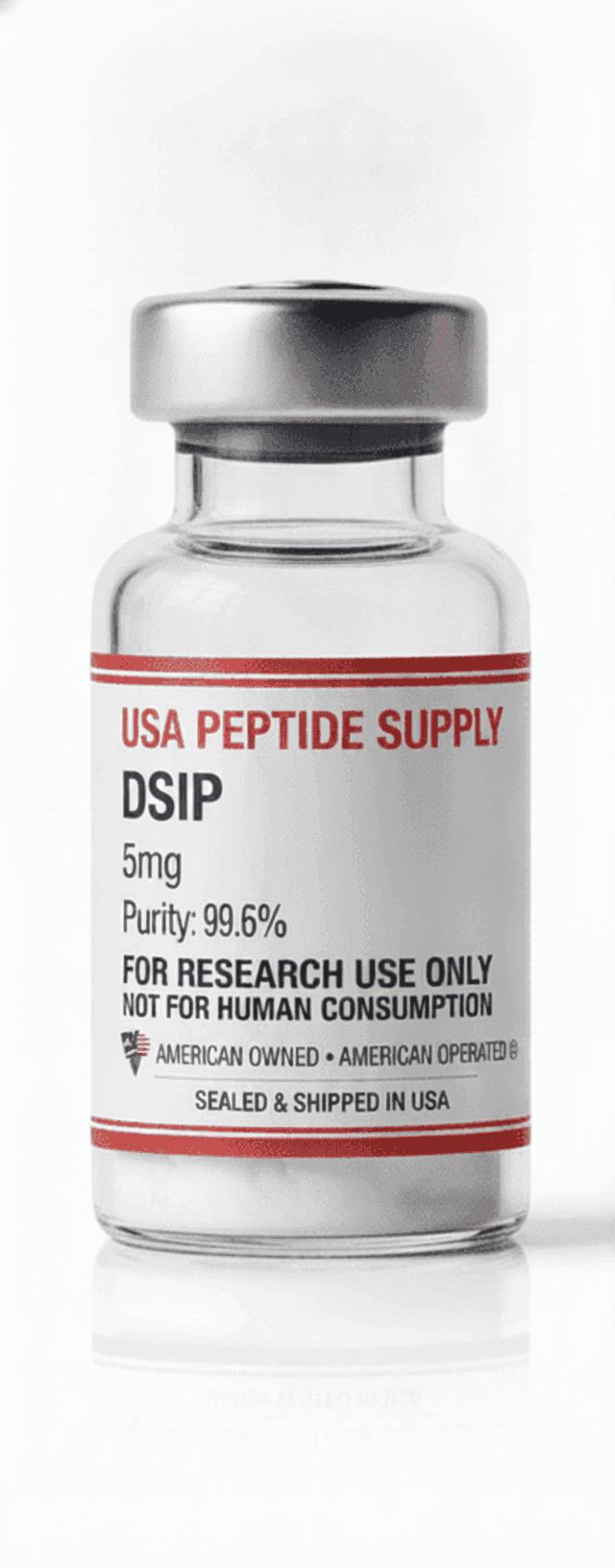
DSIP
Delta-sleep-inducing peptide for sleep and stress research.
Compound identifiers & literature
Public database identifiers and a selection of peer-reviewed publications for DSIP (Delta sleep-inducing peptide), provided so researchers can verify this compound independently. Each entry links to the primary source.
Selected literature
- [1]Graf MV, Kastin AJ (1984). Delta-sleep-inducing peptide (DSIP): a review Neuroscience and Biobehavioral Reviews 8(1):83-93.A review summarising the characterisation of DSIP as a nonapeptide of molecular weight 849, the detection of DSIP-like material by radioimmunoassay and immunohistochemistry in rat brain and by radioimmunoassay in rat peripheral organs and mammalian plasma, and reported sleep effects that differed by species: mainly delta sleep in rabbits, rats, mice and humans, whereas in cats the effect on REM sleep was described as more pronounced. The review also lists reported effects on electrophysiological activity, brain neurotransmitter levels, circadian and locomotor patterns and hormonal levels.
- [2]Kovalzon VM, Strekalova TV (2006). Delta sleep-inducing peptide (DSIP): a still unresolved riddle Journal of Neurochemistry 97(2):303-309.A critical mini-review stating that no DSIP gene, protein or related receptor has been isolated since the peptide's 1977 description from rabbit cerebral venous blood, and characterising the hypothesis of DSIP as a sleep factor as poorly documented. The authors note that significant slow-wave-sleep-promoting activity in rabbits and rats was observed for certain artificial DSIP structural analogues but not for DSIP itself, and propose the existence of a separate DSIP-like peptide to account for reported DSIP-like immunoreactivity.
- [3]Schneider-Helmert D (1987). Effects of delta-sleep-inducing peptide on 24-hour sleep-wake behaviour in severe chronic insomnia European Neurology 27(2):120-129.A placebo-controlled, double-blind study in which DSIP was administered by injection on seven successive nights to 14 middle-aged adults with chronic insomnia, with polysomnography recorded at placebo baseline, at the start and end of treatment and on one placebo post-treatment night, alongside daytime psychological state and mental performance testing. The authors reported improvement in night sleep and increases in daytime alertness and performance, and concluded the peptide was efficacious in this sample. The study is indexed as a controlled clinical trial rather than a randomised one, enrolled 14 participants, dates from 1987, and has not been replicated in modern well-powered trials.
- [4]Tukhovskaya EA, Ismailova AM, Shaykhutdinova ER, et al. (2021). Delta Sleep-Inducing Peptide Recovers Motor Function in SD Rats after Focal Stroke Molecules 26(17):5173.Intranasal DSIP at 120 micrograms per kilogram was given to Sprague-Dawley rats in a pre-treatment design, beginning 60 (plus or minus 15) minutes before intraluminal middle cerebral artery occlusion and continuing for seven days after reperfusion, with behavioural assessment on days 1, 3, 7, 14 and 21. The authors reported significant recovery of motor performance on the rotarod in DSIP-treated animals, no significant effect in the ketamine-induced rotation test, and a smaller but statistically non-significant difference in brain infarct volume (20.9 plus or minus 6.9 percent versus 24.1 plus or minus 4.6 percent in vehicle controls). Laser Doppler flowmetry was used intraoperatively to verify occlusion and reperfusion rather than as a longitudinal outcome measure.
- [5]Roy K, Chauhan G, Kumari P, et al. (2018). Phosphorylated delta sleep inducing peptide restores spatial memory and p-CREB expression by improving sleep architecture at high altitude Life Sciences 209:282-290.Phosphorylated DSIP, a modified analogue rather than DSIP itself, was given intraperitoneally at 10 micrograms per kilogram to Sprague-Dawley rats during chronic hypobaric hypoxia simulating an altitude of 7,620 metres, with non-rapid-eye-movement and rapid-eye-movement sleep architecture, Morris water maze performance and CREB phosphorylation measured. The authors reported changes in sleep architecture and water maze performance relative to untreated hypoxia-exposed animals, and reported that naloxone suppressed these effects, which they interpreted as opioid receptor involvement.
These references are provided for scientific context only. They describe published research on this compound and are not evidence of safety or efficacy, not an endorsement of any use, and not medical advice. This product is supplied for laboratory research use only — not for human or animal consumption.
For Research Use Only. Not for human or animal consumption. This product has not been evaluated by the Food and Drug Administration. Not intended to diagnose, treat, cure, or prevent any disease. DSIP is sold strictly as a research chemical for in-vitro and pre-clinical laboratory investigation only.