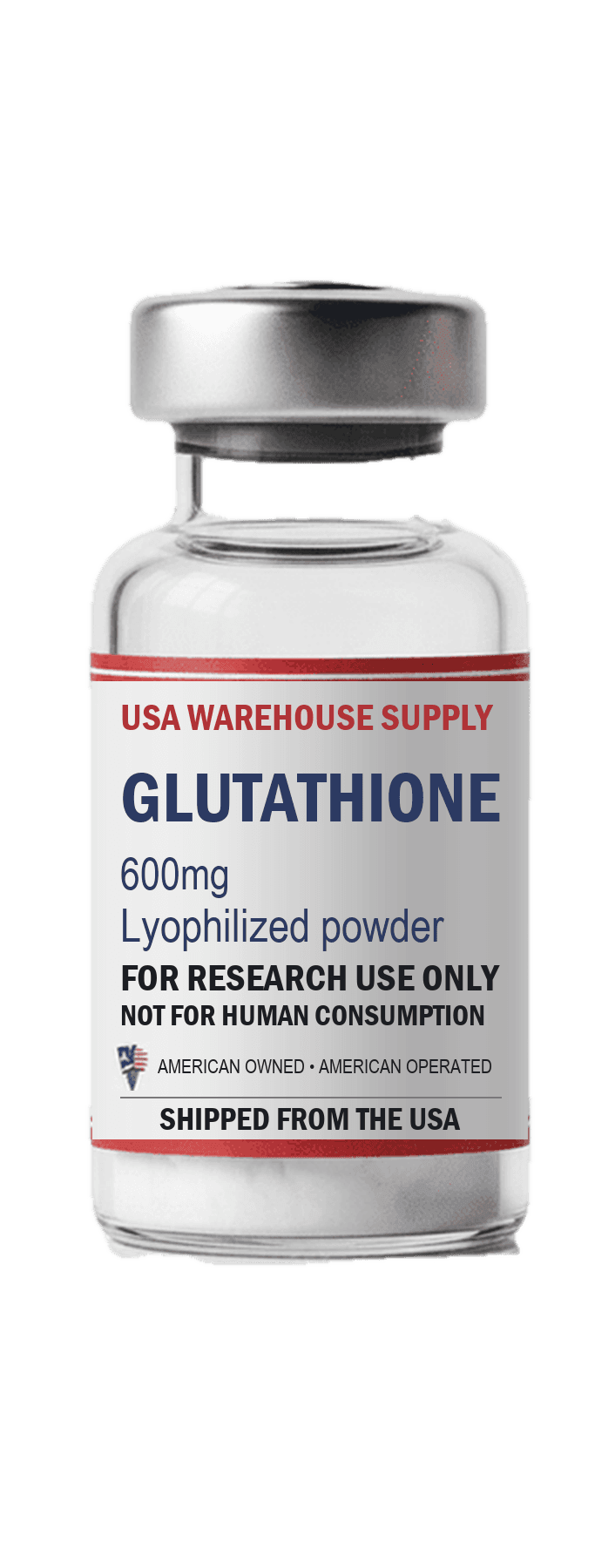
Glutathione
Glutathione (GSH), the tripeptide gamma-Glu-Cys-Gly, in a 600mg vial for redox research. Ships from the U.S..
What it is
Glutathione is the tripeptide gamma-L-glutamyl-L-cysteinylglycine (gamma-Glu-Cys-Gly), abbreviated GSH in its reduced form. Glutamate is joined to cysteine through its side-chain (gamma) carboxyl group, a linkage described as protecting GSH from hydrolysis by intracellular peptidases. Molecular formula C10H17N3O6S, molecular weight 307.33 g/mol, CAS 70-18-8, PubChem CID 124886. The cysteine carries a free thiol, and two GSH molecules exchange electrons with their disulfide form, oxidized glutathione (GSSG).
In cell and enzyme studies glutathione is described as the most abundant thiol in mammalian cells. It is the electron donor in the enzymatic reduction of hydrogen peroxide and organic peroxides, it reacts with electrophilic compounds in glutathione S-transferase reactions, and NADPH-dependent glutathione reductase converts GSSG back to GSH. The GSH/GSSG ratio is described as a marker of oxidative stress and cell redox homeostasis. USA Warehouse Supply lists glutathione as a 600mg powder vial for laboratory research use only.
Storage
- A manufacturer data sheet lists solid reduced glutathione for storage at -20°C, with stability of 4 years.
- The same data sheet recommends against keeping an aqueous solution beyond the short term.
Cited research applications
Questions
What is the difference between reduced (GSH) and oxidized (GSSG) glutathione?
Reduced glutathione (GSH) is the tripeptide gamma-Glu-Cys-Gly with a free thiol on its cysteine; oxidized glutathione (GSSG) is its disulfide form, which is reduced back to two GSH molecules. In cells glutathione is kept mostly in the reduced form, and the GSH/GSSG ratio is described as a marker of oxidative stress and cell redox homeostasis.
GSH is the electron donor in the enzymatic reduction of hydrogen peroxide and organic peroxides, and NADPH-dependent glutathione reductase converts the resulting GSSG back to GSH. Glutathione S-transferases use GSH in reactions with electrophilic compounds.
The same chemistry matters at the bench: reduced glutathione in aqueous solution oxidizes in air to GSSG, which is why supplier data advise preparing solutions fresh. USA Warehouse Supply lists glutathione (CAS 70-18-8, PubChem CID 124886) as a 600mg powder vial for laboratory research.
Compound identifiers & literature
Public database identifiers and a selection of peer-reviewed publications for Glutathione, provided so researchers can verify this compound independently. Each entry links to the primary source.
Selected literature
- [1]Lu SC (2013). Glutathione synthesis Biochimica et Biophysica Acta (General Subjects) 1830(5):3143-3153.Review of glutathione biosynthesis by glutamate-cysteine ligase and glutathione synthetase, the dependence of synthesis on cysteine availability, and the transcriptional regulation of those enzymes by Nrf2, AP-1 and NF-kB.
These references are provided for scientific context only. They describe published research on this compound and are not evidence of safety or efficacy, not an endorsement of any use, and not medical advice. This product is supplied for laboratory research use only — not for human or animal consumption.
For Research Use Only. Not for human or animal consumption. This product has not been evaluated by the Food and Drug Administration. Not intended to diagnose, treat, cure, or prevent any disease. Glutathione is sold strictly as a research chemical for in-vitro and pre-clinical laboratory investigation only.