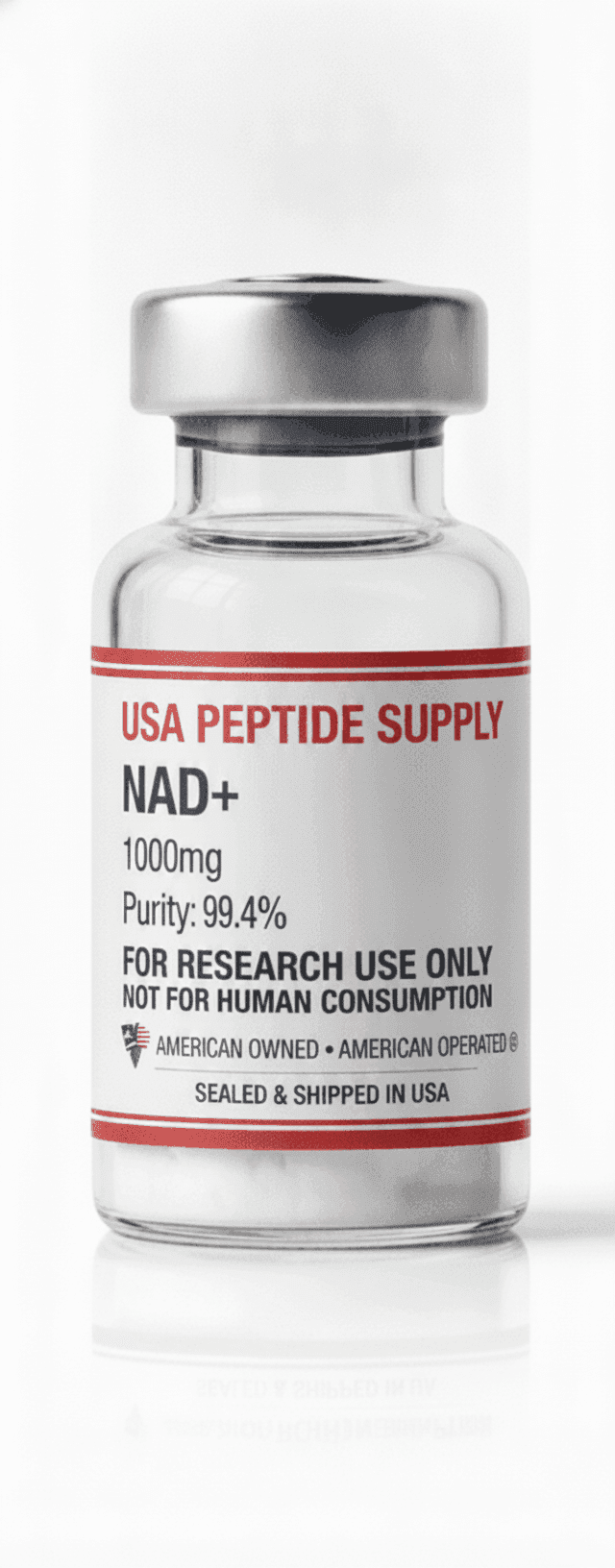
NAD+
Nicotinamide adenine dinucleotide coenzyme for cellular-energy and metabolic research.
Compound identifiers & literature
Public database identifiers and a selection of peer-reviewed publications for NAD+ (Nicotinamide adenine dinucleotide, oxidized form; INN/USAN "nadide"), provided so researchers can verify this compound independently. Each entry links to the primary source.
Selected literature
- [1]Covarrubias AJ, Perrone R, Grozio A, Verdin E (2021). NAD+ metabolism and its roles in cellular processes during ageing Nature Reviews Molecular Cell Biology.Review of NAD+ biosynthetic and consumption pathways, the enzyme classes that use NAD+ as a cofactor or substrate, and reported changes in tissue NAD+ levels during ageing.
- [2]Rajman L, Chwalek K, Sinclair DA (2018). Therapeutic Potential of NAD-Boosting Molecules: The In Vivo Evidence Cell Metabolism.Review compiling published in vivo animal data and early human data on compounds reported to raise intracellular NAD+ concentrations.
- [3]Gomes AP, Price NL, Ling AJY, et al. (2013). Declining NAD(+) induces a pseudohypoxic state disrupting nuclear-mitochondrial communication during aging Cell.Measured NAD+ levels and expression of mitochondrially encoded OXPHOS subunits in skeletal muscle of mice aged 6, 22 and 30 months, alongside cultured mouse myoblasts, and examined the effect of SIRT1 deletion on these measures. No human subjects were involved.
- [4]Martens CR, Denman BA, Mazzo MR, et al. (2018). Chronic nicotinamide riboside supplementation is well-tolerated and elevates NAD+ in healthy middle-aged and older adults Nature Communications.Randomized, double-blind, placebo-controlled crossover trial in 24 healthy middle-aged and older adults measuring NAD+ metabolites in peripheral blood mononuclear cells, blood pressure and arterial function over two 6-week periods of oral nicotinamide riboside, an NAD+ precursor rather than NAD+ itself.
- [5]Yoshino M, Yoshino J, Kayser BD, et al. (2021). Nicotinamide mononucleotide increases muscle insulin sensitivity in prediabetic women Science.Randomized, double-blind, placebo-controlled parallel-group trial in 25 postmenopausal women with prediabetes and overweight or obesity, measuring insulin-stimulated glucose disposal by hyperinsulinemic-euglycemic clamp and skeletal muscle gene expression after 10 weeks of oral nicotinamide mononucleotide, an NAD+ precursor rather than NAD+ itself.
These references are provided for scientific context only. They describe published research on this compound and are not evidence of safety or efficacy, not an endorsement of any use, and not medical advice. This product is supplied for laboratory research use only — not for human or animal consumption.
For Research Use Only. Not for human or animal consumption. This product has not been evaluated by the Food and Drug Administration. Not intended to diagnose, treat, cure, or prevent any disease. NAD+ is sold strictly as a research chemical for in-vitro and pre-clinical laboratory investigation only.