TB-500
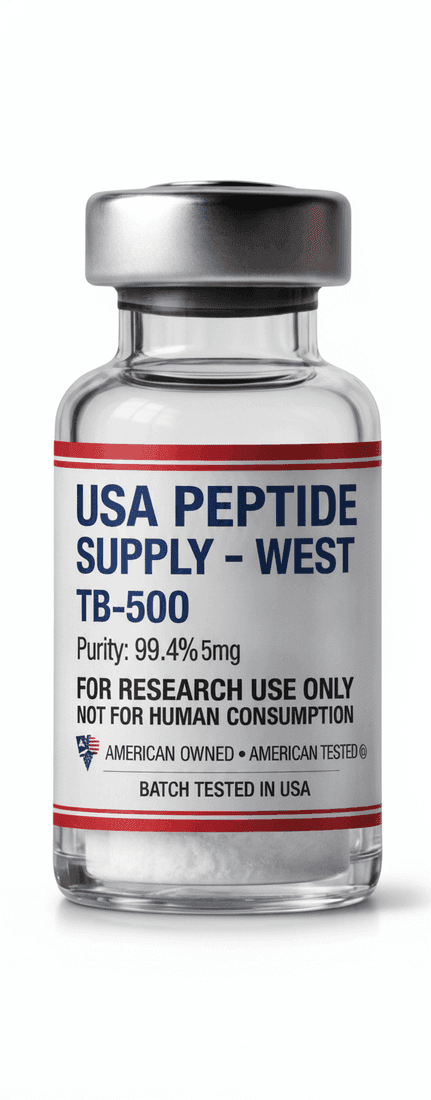
TB-500 corresponds to thymosin β-4, a 43-residue actin-sequestering peptide. It is a widely-used reference compound in actin-dynamics, angiogenesis, and cell-migration research.
An actin-sequestering reference peptide frequently paired with BPC-157 in repair models.
What it is
TB-500 is the synthetic form of thymosin β-4, a naturally occurring 43-amino-acid peptide that binds and sequesters G-actin, regulating cytoskeletal dynamics.
It is used as a reference compound in pre-clinical research on actin dynamics, angiogenesis, and cell migration. For laboratory use only.
Reconstitution & storage
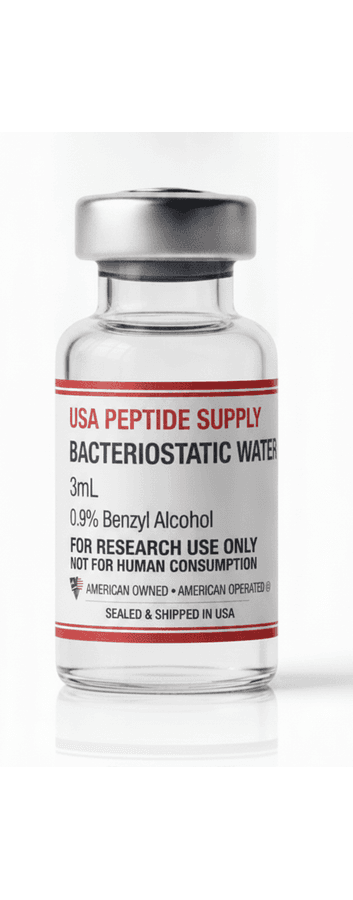
- Reconstitute with bacteriostatic water — add slowly down the vial wall and swirl gently; do not shake.
- Store lyophilized vials at -20°C; once reconstituted keep at 2–8°C and use within 16 weeks.
- Protect from light and avoid repeated freeze–thaw cycles.
Cited research applications
Questions
Compound identifiers & literature
Public database identifiers and a selection of peer-reviewed publications for TB-500 (N-acetylated thymosin beta-4 actin-binding domain heptapeptide, Ac-LKKTETQ-OH), provided so researchers can verify this compound independently. Each entry links to the primary source.
Selected literature
- [1]Philp D, Badamchian M, Scheremeta B, Nguyen M, Goldstein AL, Kleinman HK (2003). Thymosin beta 4 and a synthetic peptide containing its actin-binding domain promote dermal wound repair in db/db diabetic mice and in aged mice Wound Repair and Regeneration 11(1):19-24.Full-thickness dermal wounds in db/db diabetic mice and in 26-month-old mice were treated with full-length thymosin beta-4 in saline or hydrogel, and wound contracture, keratinocyte migration and collagen deposition were measured; a separate arm applied the seven-residue synthetic peptide LKKTETQ, reported without N-terminal acetylation, in the aged-mouse model only.
- [2]Rahaman KA, Muresan AR, Min H, Son J, Han HS, Kang MJ, Kwon OS (2024). Simultaneous quantification of TB-500 and its metabolites in in-vitro experiments and rats by UHPLC-Q-Exactive orbitrap MS/MS and their screening by wound healing activities in-vitro Journal of Chromatography B: Analytical Technologies in the Biomedical and Life Sciences 1235:124033.A UHPLC-Orbitrap mass spectrometry method was developed to quantify TB-500 and its metabolites in human serum, in-vitro enzyme systems and urine from rats dosed with TB-500; Ac-LK was the highest-concentration metabolite at 0-6 h and Ac-LKK was detected to 72 h, and in a fibroblast scratch-wound assay only the metabolite Ac-LKKTE showed activity significantly different from control, leading the authors to state that previously reported wound-healing activity of TB-500 may be attributable to that metabolite rather than to the parent compound.
- [3]Sosne G, Qiu P, Goldstein AL, Wheater M (2010). Biological activities of thymosin beta4 defined by active sites in short peptide sequences The FASEB Journal 24(7):2144-2151.A narrative review (indexed in PubMed with publication type Review) that maps reported activities of the 43-residue protein thymosin beta-4 onto discrete sequence regions, including the N-terminal Ac-SDKP tetrapeptide and the central actin-binding region described as residues 17-23 plus an additional glutamine, giving LKKTETQ, the sequence corresponding to material marketed as TB-500; it reports no new experimental data.
- [4]Delcourt V, Garcia P, Chabot B, Barnabé A, Bouscarel M, Loup B, Popot MA, Bailly-Chouriberry L (2023). TB500/TB1000 and SGF1000: A scientific approach for a better understanding of misbranded and adulterated drugs Drug Testing and Analysis 15(4):458-464.A short communication from an anti-doping laboratory in which three products sold over the internet as TB500, TB1000 and SGF1000 were analysed by mass spectrometry; the authors report that the content of the TB500/TB1000 products was not systematically consistent with their stated descriptions, and that SGF1000 consisted mainly of sheep extracellular matrix and blood proteins.analytical chemistry, no biological model (mass-spectrometric characterisation of purchased products)PMID 36482504DOI
- [5]Wang X, Liu L, Qi L, Lei C, Li P, Wang Y, Liu C, Bai H, Han C, Sun Y, Liu J (2021). A first-in-human, randomized, double-blind, single- and multiple-dose, phase I study of recombinant human thymosin β4 in healthy Chinese volunteers Journal of Cellular and Molecular Medicine 25(17):8222-8228.A phase I trial of intravenous recombinant full-length human thymosin beta-4 (NL005), which is a different molecule from the TB-500 heptapeptide: 54 healthy subjects in seven cohorts received a single dose of NL005 or placebo across 0.05-25.0 µg/kg, and 30 subjects in three cohorts received 0.5, 2.0 or 5.0 µg/kg daily for 10 days, with safety, tolerability, pharmacokinetics and anti-drug antibodies recorded over 28 days.
These references are provided for scientific context only. They describe published research on this compound and are not evidence of safety or efficacy, not an endorsement of any use, and not medical advice. This product is supplied for laboratory research use only — not for human or animal consumption.
Related compounds
For Research Use Only. Not for human or animal consumption. This product has not been evaluated by the Food and Drug Administration. Not intended to diagnose, treat, cure, or prevent any disease. TB-500 is sold strictly as a research chemical for in-vitro and pre-clinical laboratory investigation only.