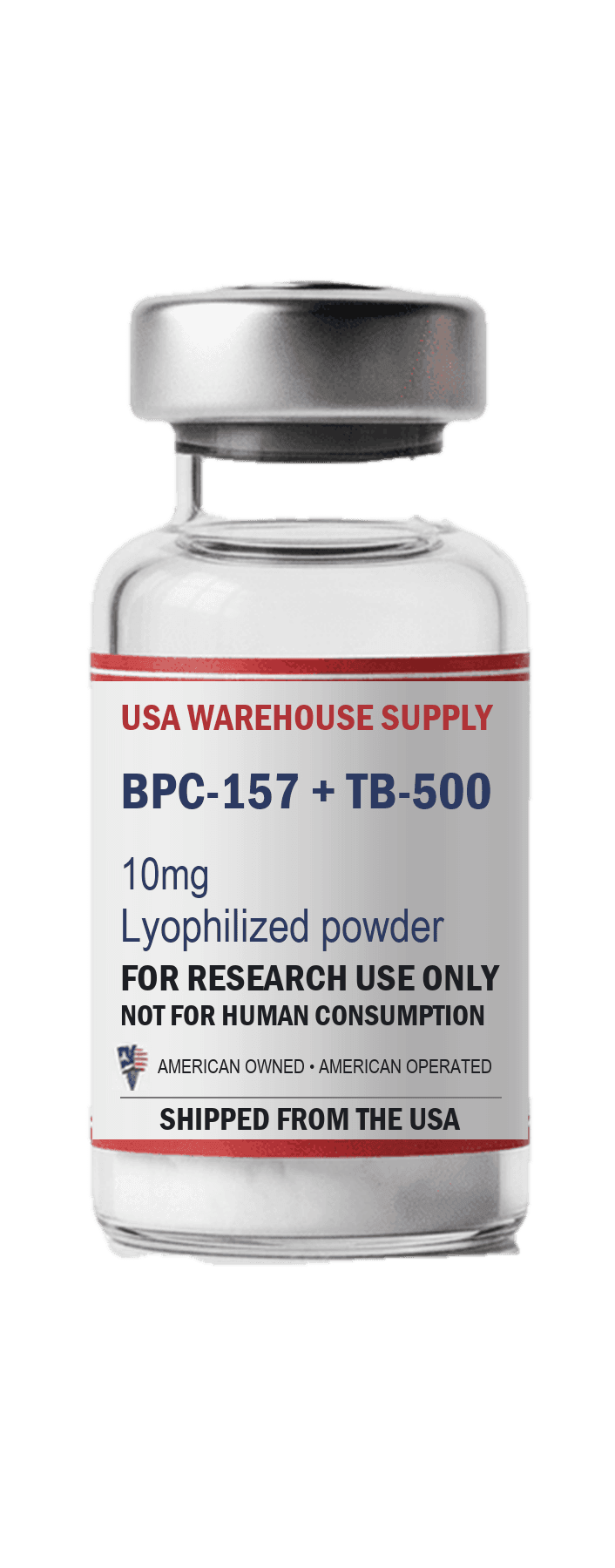
BPC-157 + TB-500
BPC-157 and TB-500 lyophilized together in one 10mg vial, for laboratory research on tendon, actin and cell-motility models. Research use only.
What it is
The BPC-157 + TB-500 blend supplies two research peptides in one 10mg lyophilized vial. BPC-157 is a synthetic 15-residue fragment of a protein first isolated from human gastric juice, molecular formula C62H98N16O22, molecular weight 1419.5 g/mol. TB-500 here is full-length thymosin beta-4, a 43-residue peptide with an acetylated N-terminal serine that binds monomeric G-actin, molecular weight about 4963 g/mol.
The two peptides come from different research lines. BPC-157 appears in rat tendon, ligament and muscle models and in cultured tendon fibroblasts, with work on VEGF, nitric oxide and FAK-paxillin signaling. Thymosin beta-4 work centers on G-actin sequestration, cell motility, and dermal and corneal wound models. A single vial suits study designs that keep both compounds together at the ratio set when the vial was filled. Each vial ships from the U.S., for laboratory research use only.
Storage
- Published data are per peptide, not for the blend: an FDA briefing document reports lyophilized BPC-157 is best stored desiccated below -18°C, and manufacturer data sheets list full-length thymosin beta-4 powder at -20°C.
- In solution, a manufacturer figure was found only for thymosin beta-4: one sheet for a recombinant form lists up to one month at 2 to 8°C or up to three months at -20 to -70°C.
- A general peptide handling guide from a reagent manufacturer advises warming the vial to room temperature in a desiccator before opening, and freezing solutions in aliquots below -15°C.
Cited research applications
Questions
What is in the BPC-157 and TB-500 blend?
The BPC-157 and TB-500 blend is a two-peptide research preparation supplied as one 10mg lyophilized vial containing both compounds; the supplier has not yet confirmed the split between them in writing, so no per-component amount is stated here. BPC-157 is a synthetic 15-residue peptide, Gly-Glu-Pro-Pro-Pro-Gly-Lys-Pro-Ala-Asp-Asp-Ala-Gly-Leu-Val, with free termini, molecular weight 1419.5 g/mol, CAS 137525-51-0. The TB-500 in this blend is full-length thymosin beta-4, the N-terminally acetylated 43-residue actin-binding peptide, molecular formula C212H350N56O78S, molecular weight about 4963 g/mol, CAS 77591-33-4. The two compounds are studied in different model systems, in cell culture and rodents: BPC-157 in angiogenesis, fibroblast-migration and gut-mucosa models, TB-500 in actin-sequestration and cell-migration models.
BPC-157 and TB-500: blend or separate vials?
A blend vial and two separate vials hold the same two compounds; the difference is how a study can use them. In the blend, BPC-157 and TB-500 are lyophilized together in one 10mg vial, so reconstitution gives one solution with a ratio fixed when the vial was filled. Separate BPC-157 and TB-500 vials let a lab set each concentration on its own, leave one compound out, and run single-compound control arms.
Handling data are published per peptide, not for the mixture. An FDA briefing document reports lyophilized BPC-157 is best stored desiccated below -18°C, and manufacturer data sheets list full-length thymosin beta-4 powder at -20°C.
Compound identifiers & literature
Public database identifiers and a selection of peer-reviewed publications for the compounds in this blend: BPC-157 (Body Protection Compound-157) and Thymosin beta-4 (full-length, 43 residues; sold as TB-500), provided so researchers can verify each compound independently. Each entry links to the primary source.
BPC-157 (Body Protection Compound-157)
Selected literature
- [1]Gwyer D, Wragg NM, Wilson SL (2019). Gastric pentadecapeptide body protection compound BPC 157 and its role in accelerating musculoskeletal soft tissue healing Cell and Tissue Research.Narrative review of published tendon, ligament, and skeletal muscle injury studies involving BPC-157; the authors report that the studies they surveyed described positive healing effects, while stating that the majority of that literature was generated in small rodent models, that efficacy has not been confirmed in humans, and that the precise healing mechanisms are not yet understood.
- [2]Chang CH, Tsai WC, Lin MS, Hsu YH, Pang JH (2011). The promoting effect of pentadecapeptide BPC 157 on tendon healing involves tendon outgrowth, cell survival, and cell migration Journal of Applied Physiology (1985).In vitro and ex vivo study in which rat Achilles tendon explants and cultured rat tendon fibroblasts were exposed to BPC-157; the authors report accelerated explant outgrowth, increased cell survival under hydrogen peroxide stress, dose-dependent increases in fibroblast migration and spreading, and dose-dependent increases in FAK and paxillin phosphorylation, with no direct effect on cell proliferation by MTT assay. No live animals were treated in this study.
- [3]Japjec M, Horvat Pavlov K, Petrovic A, Staresinic M, Sebecic B, Buljan M, Vranes H, Giljanovic A, Drmic D, Prtoric A, Lovric E, Batelja Vuletic L, Dobric I, Boban Blagaic A, Skrtic A, Seiwerth S, Sikiric P (2021). Stable Gastric Pentadecapeptide BPC 157 as a Therapy for the Disable Myotendinous Junctions in Rats Biomedicines.Rat study in which the quadriceps tendon was surgically separated from the quadriceps muscle to create a myotendinous junction defect; BPC-157-treated animals were compared with controls using macroscopic, microscopic, biomechanical and functional assessment plus eNOS and COX-2 mRNA levels and oxidative stress and nitric oxide measures, with observations reported at timepoints including 28 and 42 days.
Thymosin beta-4 (full-length, 43 residues; sold as TB-500)
Selected literature
- [4]Safer D, Elzinga M, Nachmias VT (1991). Thymosin beta 4 and Fx, an actin-sequestering peptide, are indistinguishable The Journal of biological chemistry 266(7):4029-32.Showed that Fx, an acidic, heat-stable 5-kDa peptide complexed with unpolymerized actin in platelets, has an amino acid sequence identical with thymosin beta-4. Authentic thymosin beta-4 formed a 1:1 complex with actin monomers and inhibited salt-induced polymerization of G-actin, identifying it as an actin-sequestering peptide.in vitro (protein biochemistry: platelet extracts, purified muscle G-actin, sequencing)PMID 1999398
- [5]Malinda KM, Sidhu GS, Mani H, Banaudha K, Maheshwari RK, Goldstein AL, Kleinman HK (1999). Thymosin beta4 accelerates wound healing The Journal of investigative dermatology 113(3):364-8.Examined thymosin beta-4 in a rat full-thickness wound model, measuring reepithelialization, wound contraction, collagen deposition and angiogenesis, and tested keratinocyte migration toward thymosin beta-4 in a Boyden chamber assay.rodent (rat full-thickness dermal wound model) and in vitro (keratinocyte migration, Boyden chamber)PMID 10469335DOI
- [6]Sosne G, Christopherson PL, Barrett RP, Fridman R (2005). Thymosin-beta4 modulates corneal matrix metalloproteinase levels and polymorphonuclear cell infiltration after alkali injury Investigative ophthalmology & visual science 46(7):2388-95.Examined thymosin beta-4 in a mouse corneal alkali injury model, measuring polymorphonuclear leukocyte infiltration, the chemokines KC (CXCL1) and MIP-2, matrix metalloproteinases MMP-2, MMP-9 and MT6-MMP and the inhibitors TIMP-1 and TIMP-2, with MMP-9 localised by immunohistochemistry.
- [7]Philp D, Badamchian M, Scheremeta B, Nguyen M, Goldstein AL, Kleinman HK (2003). Thymosin beta 4 and a synthetic peptide containing its actin-binding domain promote dermal wound repair in db/db diabetic mice and in aged mice Wound repair and regeneration : official publication of the Wound Healing Society [and] the European Tissue Repair Society 11(1):19-24.Compared full-length thymosin beta-4, in buffered saline or a hydrogel formulation, with the synthetic seven-residue actin-binding-domain peptide LKKTETQ in full-thickness dermal wound models in rats, db/db diabetic mice and aged mice, measuring wound contracture, collagen deposition and keratinocyte migration.rodent (full-thickness dermal wounds in normal rats, db/db diabetic mice and 26-month-old mice)PMID 12581423DOI
These references are provided for scientific context only. They describe published research on this compound and are not evidence of safety or efficacy, not an endorsement of any use, and not medical advice. This product is supplied for laboratory research use only — not for human or animal consumption.
For Research Use Only. Not for human or animal consumption. This product has not been evaluated by the Food and Drug Administration. Not intended to diagnose, treat, cure, or prevent any disease. BPC-157 + TB-500 is sold strictly as a research chemical for in-vitro and pre-clinical laboratory investigation only.