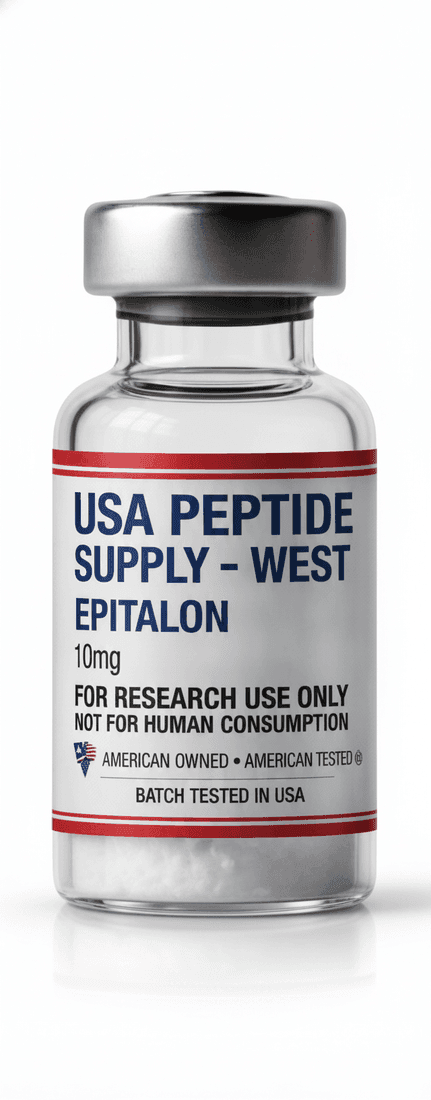
Epitalon
Epitalon is a synthetic tetrapeptide (Ala-Glu-Asp-Gly) modeled on the pineal peptide epithalamin. It is a widely-referenced tool compound in telomere-biology and pineal-axis research.
The most-cited research-grade reference for telomerase-modulation studies.
What it is
Epitalon (epithalon) is a short synthetic tetrapeptide with the sequence Ala-Glu-Asp-Gly, derived from the naturally occurring pineal peptide epithalamin. Its low molecular weight makes it a convenient reference standard.
It appears across pre-clinical literature as a tool compound for telomerase-activity assays, pineal-axis signaling, and circadian gene-expression research. For laboratory use only.
Reconstitution & storage
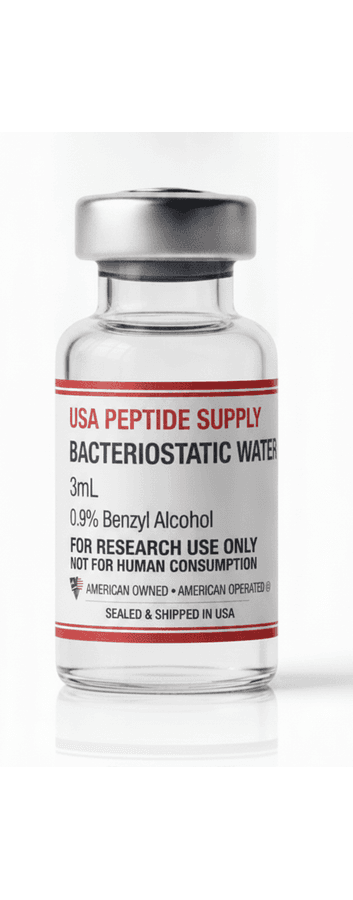
- Reconstitute with bacteriostatic water — add slowly down the vial wall and swirl gently; do not shake.
- Store lyophilized vials at -20°C; once reconstituted keep at 2–8°C and use within 16 weeks.
- Protect from light and avoid repeated freeze–thaw cycles.
Cited research applications
Questions
Compound identifiers & literature
Public database identifiers and a selection of peer-reviewed publications for Epitalon (Epithalon; AEDG tetrapeptide), provided so researchers can verify this compound independently. Each entry links to the primary source.
Selected literature
- [1]Araj SK, Brzezik J, Mądra-Gackowska K, Szeleszczuk Ł (2025). Overview of Epitalon-Highly Bioactive Pineal Tetrapeptide with Promising Properties International Journal of Molecular Sciences.A narrative review of roughly 25 years of published work on the AEDG tetrapeptide, covering reported effects on melatonin synthesis, gene expression and enzyme activity, and stating that the peptide's physicochemical characterisation and mechanism of action remain incompletely defined.
- [2]Al-Dulaimi S, Thomas R, Matta S, Roberts T (2025). Epitalon increases telomere length in human cell lines through telomerase upregulation or ALT activity Biogerontology.Cultured breast cancer cell lines (21NT, BT474) and normal human epithelial and fibroblast cells were treated with epitalon, and telomere length, hTERT mRNA expression, telomerase activity and alternative lengthening of telomeres (ALT) activity were quantified by qPCR and immunofluorescence; the authors reported dose-dependent telomere lengthening in the normal cell cultures via hTERT and telomerase upregulation and, in the cancer cell lines, via ALT activation. A correction to this article was subsequently published (PMID 41240216).
- [3]Khavinson VKh, Bondarev IE, Butyugov AA (2003). Epithalon peptide induces telomerase activity and telomere elongation in human somatic cells Bulletin of Experimental Biology and Medicine.Telomerase-negative cultured human fetal fibroblasts were exposed to the peptide, and expression of the telomerase catalytic subunit, telomerase enzymatic activity and telomere length were measured. Despite the phrase 'human somatic cells' in the title, this is a cell-culture study and involved no human subjects.
- [4]Anisimov VN, Popovich IG, Zabezhinskiĭ MA, Rozenfel'd SV, Khavinson VKh, Semenchenko AV, Iashin AI (2005). [Effect of epitalon and melatonin on life span and spontaneous carcinogenesis in senescence accelerated mice (SAM)] Voprosy Onkologii.Female senescence-accelerated SAMP-1 and SAMR-1 mice received subcutaneous epitalon (1 µg per mouse) five times per week in monthly courses, or melatonin, with body weight, temperature, food consumption, estrous function, lifespan, mortality rate dynamics and spontaneous tumour incidence recorded. Russian-language article; the bracketed title is PubMed's English translation and an English abstract is indexed.rodentPMID 15909815
- [5]Yue X, Liu SL, Guo JN, Meng TG, Zhang XR, Li HX, Song CY, Wang ZB, Schatten H, Sun QY, Guo XP (2022). Epitalon protects against post-ovulatory aging-related damage of mouse oocytes in vitro Aging (Albany NY).Epitalon at 0.1 mM was added to the culture medium of mouse oocytes and oocyte quality was assessed after 6, 12 and 24 hours of in vitro culture, measuring intracellular reactive oxygen species, spindle defects, cortical granule distribution, mitochondrial membrane potential, mitochondrial DNA copy number and apoptosis. No animals were treated; the peptide was applied to oocytes in culture.
These references are provided for scientific context only. They describe published research on this compound and are not evidence of safety or efficacy, not an endorsement of any use, and not medical advice. This product is supplied for laboratory research use only — not for human or animal consumption.
Related compounds
For Research Use Only. Not for human or animal consumption. This product has not been evaluated by the Food and Drug Administration. Not intended to diagnose, treat, cure, or prevent any disease. Epitalon is sold strictly as a research chemical for in-vitro and pre-clinical laboratory investigation only.