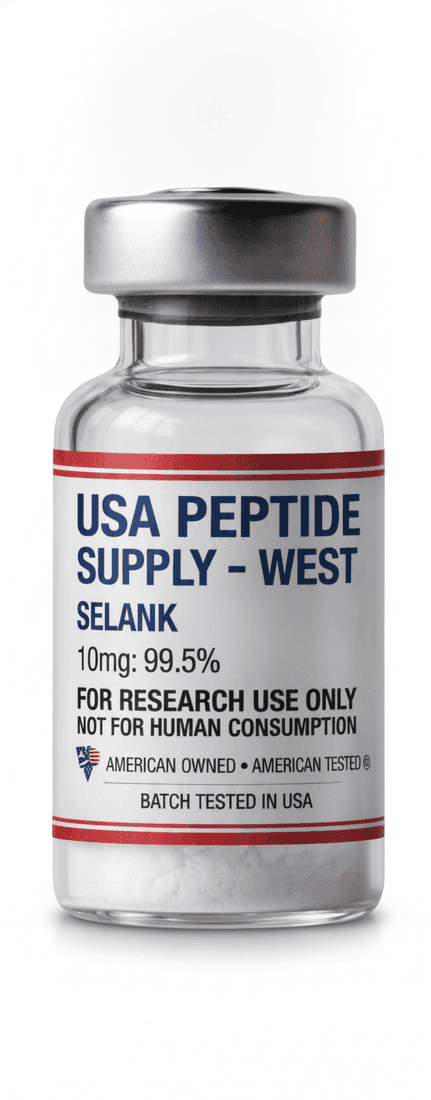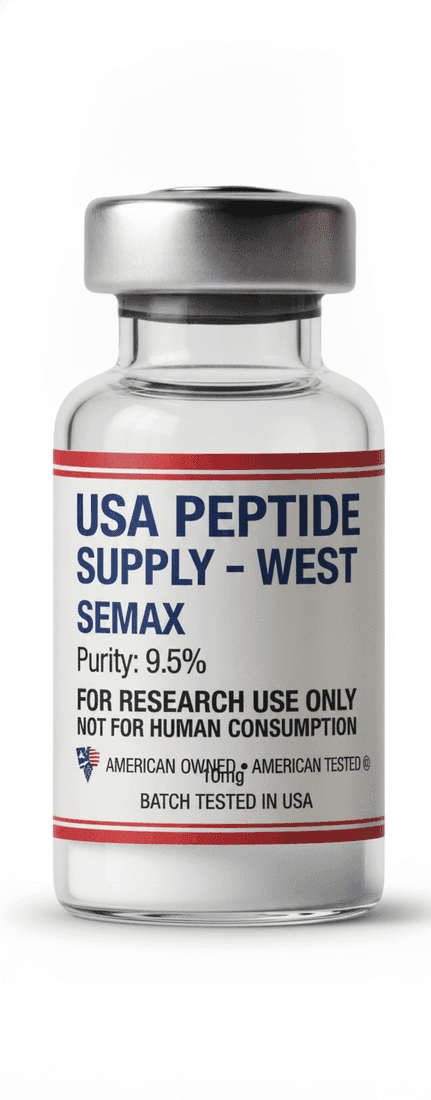
Semax
Semax is a synthetic heptapeptide analog of the ACTH(4-10) fragment, modified with a Pro-Gly-Pro tail for stability. It is a reference compound in neurotrophic-factor expression and neuropeptide signaling research.
A stabilized ACTH-fragment reference peptide for neurotrophic-pathway studies.
What it is
Semax is a synthetic peptide based on the 4-10 fragment of adrenocorticotropic hormone (ACTH), modified with a Pro-Gly-Pro tail that resists enzymatic breakdown.
It is used as a tool compound in pre-clinical neuropeptide and neurotrophic-factor expression research. Supplied for laboratory use only.
Reconstitution & storage
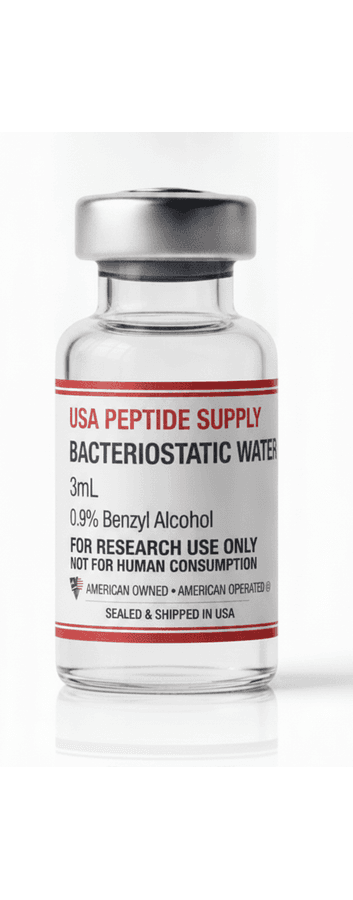
- Reconstitute with bacteriostatic water — add slowly down the vial wall and swirl gently; do not shake.
- Store lyophilized vials at -20°C; once reconstituted keep at 2–8°C and use within 16 weeks.
- Protect from light and avoid repeated freeze–thaw cycles.
Cited research applications
Questions
Compound identifiers & literature
Public database identifiers and a selection of peer-reviewed publications for Semax, provided so researchers can verify this compound independently. Each entry links to the primary source.
Selected literature
- [1]Dolotov OV, Karpenko EA, Seredenina TS, et al. (2006). Semax, an analogue of adrenocorticotropin (4-10), binds specifically and increases levels of brain-derived neurotrophic factor protein in rat basal forebrain Journal of Neurochemistry.Measured binding of tritium-labelled peptide to cell membranes isolated from rat basal forebrain, reporting time-dependent, reversible, calcium-dependent binding with a dissociation constant of 2.4 +/- 1.0 nM, and quantified BDNF protein by immunoenzymatic assay in basal forebrain and cerebellum 3 hours after intranasal administration at 50 and 250 microg/kg.
- [2]Eremin KO, Kudrin VS, Saransaari P, et al. (2005). Semax, an ACTH(4-10) analogue with nootropic properties, activates dopaminergic and serotoninergic brain systems in rodents Neurochemical Research.Measured tissue and extracellular striatal concentrations of dopamine, its metabolites, and the serotonin metabolite 5-HIAA in C57BL mice using in vivo microdialysis, together with locomotor activity, after intraperitoneal administration (0.15 mg/kg) alone and 20 minutes before D-amphetamine; tissue and extracellular dopamine were not altered by the peptide alone.
- [3]Medvedeva EV, Dmitrieva VG, Povarova OV, et al. (2014). The peptide semax affects the expression of genes related to the immune and vascular systems in rat brain focal ischemia: genome-wide transcriptional analysis BMC Genomics.Performed genome-wide transcriptional profiling of rat brain cortex tissue at 3 and 24 hours after permanent middle cerebral artery occlusion, comparing peptide-treated animals with ischaemic controls; reported differentially expressed transcripts concentrated in immune-system and vascular-system gene categories.
- [4]Gusev EI, Martynov MY, Kostenko EV, Petrova LV, Bobyreva SN (2018). [The efficacy of semax in the tretament of patients at different stages of ischemic stroke] Zhurnal Nevrologii i Psikhiatrii imeni S.S. Korsakova.Clinical study in 110 post-ischaemic-stroke patients (43 men, 67 women; mean age 58.0 +/- 9.7 years) allocated to early (89 +/- 9 days) or late (214 +/- 22 days) rehabilitation groups, each subdivided into semax-treated and untreated subgroups; measured plasma BDNF concentrations, British Medical Research Council motor scale scores and Barthel index. Reported dosing was two 10-day courses of 6000 mcg/day separated by a 20-day interval. The abstract describes no placebo control and no blinding.
- [5]Liu R, Chen Y, Huang H, et al. (2025). Semax peptide targets the μ opioid receptor gene Oprm1 to promote deubiquitination and functional recovery after spinal cord injury in female mice British Journal of Pharmacology.Administered the peptide to female C57BL/6 mice after T9-T10 contusive spinal cord injury and recorded Basso locomotor scores, footprint analysis and inclined-plane testing, alongside assays of oxidative stress and pyroptosis markers, reporting a mu-opioid receptor (Oprm1)-associated pathway in which USP18 alters ubiquitination of FTO.
These references are provided for scientific context only. They describe published research on this compound and are not evidence of safety or efficacy, not an endorsement of any use, and not medical advice. This product is supplied for laboratory research use only — not for human or animal consumption.
Related compounds
For Research Use Only. Not for human or animal consumption. This product has not been evaluated by the Food and Drug Administration. Not intended to diagnose, treat, cure, or prevent any disease. Semax is sold strictly as a research chemical for in-vitro and pre-clinical laboratory investigation only.