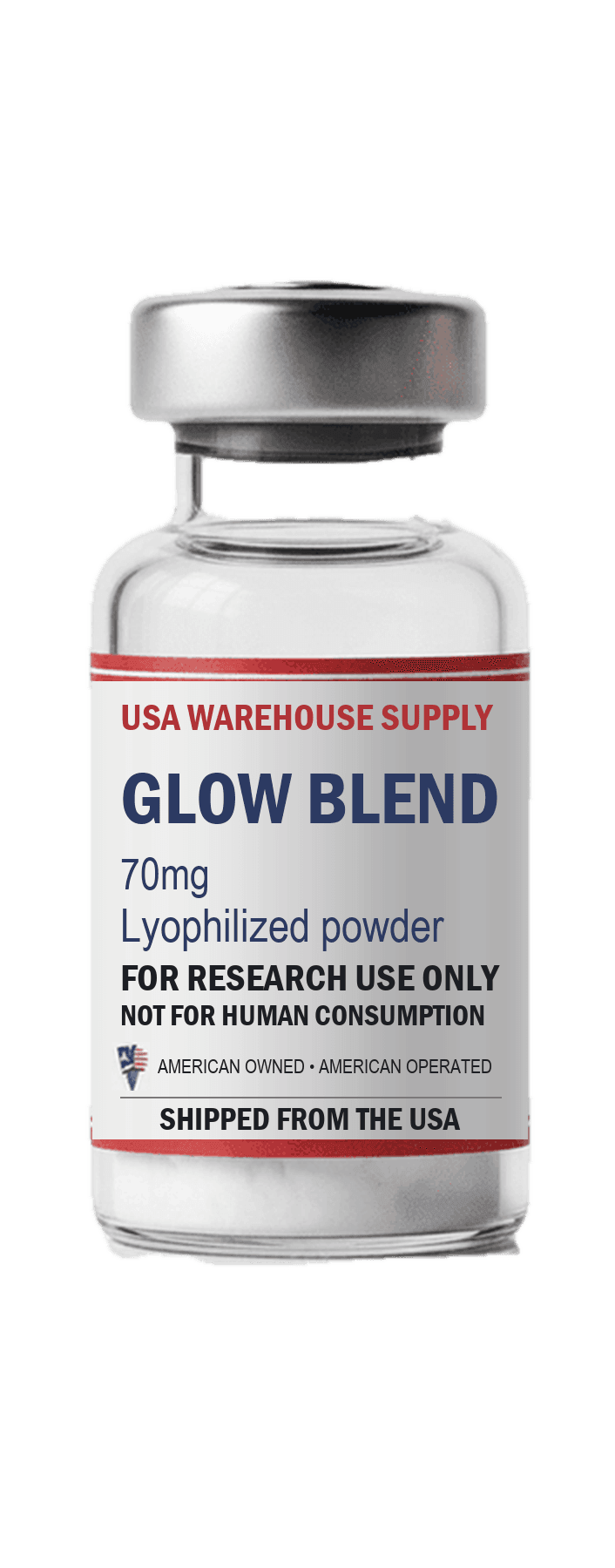
GLOW Blend
GLOW is a three-component research blend supplied as one 70mg vial: 50mg GHK-Cu, 10mg BPC-157 and 10mg TB-500. It gives extracellular-matrix, angiogenesis and actin-dynamics models a single source of all three reference compounds.
Three widely referenced extracellular-matrix and actin-model reference compounds, combined in one vial.
What it is
GLOW combines three peptides in one lyophilized vial: GHK-Cu, the copper(II) complex of Gly-His-Lys (50mg); BPC-157, a 15-residue gastric-protein fragment (10mg); and TB-500, full-length thymosin beta-4 (10mg). GHK-Cu makes up about 71% of the labeled mass and outnumbers BPC-157 roughly 18 to 1 by molecule count.
No published study has examined these three compounds together, and whether the copper in GHK-Cu interacts with the other two components in solution has not been characterized. The blend is offered as combined source material for laboratory work on each pathway. Supplied strictly for laboratory research.
Storage
- Store lyophilized vials at -20°C and follow the storage window on the label.
- Protect from light and avoid repeated freeze-thaw cycles.
Cited research applications
Questions
Compound identifiers & literature
Public database identifiers and a selection of peer-reviewed publications for the compounds in this blend: GHK-Cu (Copper tripeptide-1), BPC-157 (Body Protection Compound-157) and Thymosin beta-4 (full-length, 43 residues; sold as TB-500), provided so researchers can verify each compound independently. Each entry links to the primary source.
GHK-Cu (Copper tripeptide-1)
Selected literature
- [1]Pickart L, Margolina A (2018). Regenerative and Protective Actions of the GHK-Cu Peptide in the Light of the New Gene Data International Journal of Molecular Sciences, 19(7):1987.Narrative review compiling previously published gene-expression, cell-culture and animal-model reports on the GHK peptide and its copper complex; indexed in PubMed as a Review and containing no new experimental data.
- [2]Pickart L, Vasquez-Soltero JM, Margolina A (2015). GHK Peptide as a Natural Modulator of Multiple Cellular Pathways in Skin Regeneration BioMed Research International, 2015:648108.Narrative review of the reported literature on GHK in skin tissue, covering in vitro, animal and cosmetic-study reports of collagen synthesis, metalloproteinase modulation and gene expression; indexed in PubMed as a Review and containing no new experimental data.
- [3]Maquart FX, Pickart L, Laurent M, Gillery P, Monboisse JC, Borel JP (1988). Stimulation of collagen synthesis in fibroblast cultures by the tripeptide-copper complex glycyl-L-histidyl-L-lysine-Cu2+ FEBS Letters, 238(2):343-346.Measured collagen synthesis in cultured fibroblasts exposed to GHK-Cu. The authors report stimulation beginning between 10^-12 and 10^-11 M and maximal at 10^-9 M, and state the effect was independent of any change in cell number.
- [4]Siméon A, Emonard H, Hornebeck W, Maquart FX (2000). The tripeptide-copper complex glycyl-L-histidyl-L-lysine-Cu2+ stimulates matrix metalloproteinase-2 expression by fibroblast cultures Life Sciences, 67(18):2257-2265.Measured matrix metalloproteinase-2 in conditioned media of cultured dermal fibroblasts treated with GHK-Cu, reporting increased MMP-2 protein and mRNA alongside increased secretion of the tissue inhibitors TIMP-1 and TIMP-2. The authors report the effect was reproduced by copper ions alone but not by the copper-free GHK peptide.
- [5]Fu SC, Cheuk YC, Chiu WY, Yung SH, Rolf CG, Chan KM (2015). Tripeptide-copper complex GHK-Cu (II) transiently improved healing outcome in a rat model of ACL reconstruction Journal of Orthopaedic Research, 33(7):1024-1033.Seventy-two rats underwent unilateral anterior cruciate ligament reconstruction and were randomized to saline or GHK-Cu for four weeks beginning at week 2. At 6 weeks the GHK-Cu groups showed a smaller side-to-side knee laxity difference and the lower-concentration group a higher graft stiffness; no significant difference was found at 12 weeks, and no significant difference in ultimate load, gait parameters or histological scores was found at any timepoint.
BPC-157 (Body Protection Compound-157)
Selected literature
- [6]Gwyer D, Wragg NM, Wilson SL (2019). Gastric pentadecapeptide body protection compound BPC 157 and its role in accelerating musculoskeletal soft tissue healing Cell and Tissue Research.Narrative review of published tendon, ligament, and skeletal muscle injury studies involving BPC-157; the authors report that the studies they surveyed described positive healing effects, while stating that the majority of that literature was generated in small rodent models, that efficacy has not been confirmed in humans, and that the precise healing mechanisms are not yet understood.
- [7]Chang CH, Tsai WC, Lin MS, Hsu YH, Pang JH (2011). The promoting effect of pentadecapeptide BPC 157 on tendon healing involves tendon outgrowth, cell survival, and cell migration Journal of Applied Physiology (1985).In vitro and ex vivo study in which rat Achilles tendon explants and cultured rat tendon fibroblasts were exposed to BPC-157; the authors report accelerated explant outgrowth, increased cell survival under hydrogen peroxide stress, dose-dependent increases in fibroblast migration and spreading, and dose-dependent increases in FAK and paxillin phosphorylation, with no direct effect on cell proliferation by MTT assay. No live animals were treated in this study.
- [8]Japjec M, Horvat Pavlov K, Petrovic A, Staresinic M, Sebecic B, Buljan M, Vranes H, Giljanovic A, Drmic D, Prtoric A, Lovric E, Batelja Vuletic L, Dobric I, Boban Blagaic A, Skrtic A, Seiwerth S, Sikiric P (2021). Stable Gastric Pentadecapeptide BPC 157 as a Therapy for the Disable Myotendinous Junctions in Rats Biomedicines.Rat study in which the quadriceps tendon was surgically separated from the quadriceps muscle to create a myotendinous junction defect; BPC-157-treated animals were compared with controls using macroscopic, microscopic, biomechanical and functional assessment plus eNOS and COX-2 mRNA levels and oxidative stress and nitric oxide measures, with observations reported at timepoints including 28 and 42 days.
Thymosin beta-4 (full-length, 43 residues; sold as TB-500)
Selected literature
- [9]Safer D, Elzinga M, Nachmias VT (1991). Thymosin beta 4 and Fx, an actin-sequestering peptide, are indistinguishable The Journal of biological chemistry 266(7):4029-32.Showed that Fx, an acidic, heat-stable 5-kDa peptide complexed with unpolymerized actin in platelets, has an amino acid sequence identical with thymosin beta-4. Authentic thymosin beta-4 formed a 1:1 complex with actin monomers and inhibited salt-induced polymerization of G-actin, identifying it as an actin-sequestering peptide.in vitro (protein biochemistry: platelet extracts, purified muscle G-actin, sequencing)PMID 1999398
- [10]Malinda KM, Sidhu GS, Mani H, Banaudha K, Maheshwari RK, Goldstein AL, Kleinman HK (1999). Thymosin beta4 accelerates wound healing The Journal of investigative dermatology 113(3):364-8.Examined thymosin beta-4 in a rat full-thickness wound model, measuring reepithelialization, wound contraction, collagen deposition and angiogenesis, and tested keratinocyte migration toward thymosin beta-4 in a Boyden chamber assay.rodent (rat full-thickness dermal wound model) and in vitro (keratinocyte migration, Boyden chamber)PMID 10469335DOI
- [11]Sosne G, Christopherson PL, Barrett RP, Fridman R (2005). Thymosin-beta4 modulates corneal matrix metalloproteinase levels and polymorphonuclear cell infiltration after alkali injury Investigative ophthalmology & visual science 46(7):2388-95.Examined thymosin beta-4 in a mouse corneal alkali injury model, measuring polymorphonuclear leukocyte infiltration, the chemokines KC (CXCL1) and MIP-2, matrix metalloproteinases MMP-2, MMP-9 and MT6-MMP and the inhibitors TIMP-1 and TIMP-2, with MMP-9 localised by immunohistochemistry.
- [12]Philp D, Badamchian M, Scheremeta B, Nguyen M, Goldstein AL, Kleinman HK (2003). Thymosin beta 4 and a synthetic peptide containing its actin-binding domain promote dermal wound repair in db/db diabetic mice and in aged mice Wound repair and regeneration : official publication of the Wound Healing Society [and] the European Tissue Repair Society 11(1):19-24.Compared full-length thymosin beta-4, in buffered saline or a hydrogel formulation, with the synthetic seven-residue actin-binding-domain peptide LKKTETQ in full-thickness dermal wound models in rats, db/db diabetic mice and aged mice, measuring wound contracture, collagen deposition and keratinocyte migration.rodent (full-thickness dermal wounds in normal rats, db/db diabetic mice and 26-month-old mice)PMID 12581423DOI
These references are provided for scientific context only. They describe published research on this compound and are not evidence of safety or efficacy, not an endorsement of any use, and not medical advice. This product is supplied for laboratory research use only — not for human or animal consumption.
Related compounds
For Research Use Only. Not for human or animal consumption. This product has not been evaluated by the Food and Drug Administration. Not intended to diagnose, treat, cure, or prevent any disease. GLOW Blend is sold strictly as a research chemical for in-vitro and pre-clinical laboratory investigation only.