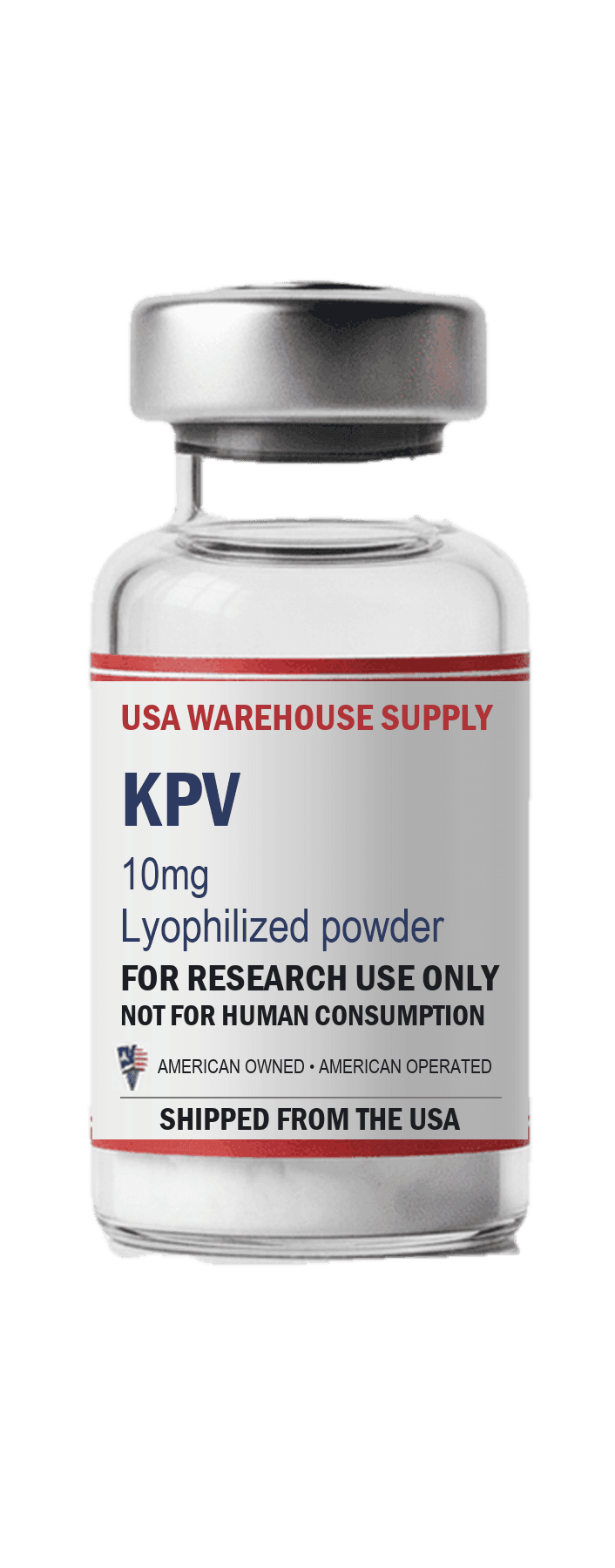
KPV
KPV (Lys-Pro-Val) is a synthetic tripeptide matching residues 11 to 13 at the C-terminus of alpha-melanocyte-stimulating hormone (alpha-MSH). It is a compact reference compound in melanocortin-fragment, NF-kB signaling and intestinal-epithelium research.
A three-residue alpha-MSH fragment for melanocortin-pathway and epithelial-model studies.
What it is
KPV is H-Lys-Pro-Val-OH, the C-terminal tripeptide of alpha-MSH, which is itself processed from pro-opiomelanocortin (POMC). PubChem records the free acid as alpha-MSH (11-13). Its small size and simple sequence make it a convenient laboratory reference standard.
Published work with KPV comes from cell cultures and rodent models, including keratinocyte signaling assays, intestinal-epithelium models and uptake studies through the PepT1 peptide transporter. Supplied for laboratory use only.
Storage
- Store lyophilized vials at -20°C and follow the storage window on the label.
- Protect from light and avoid repeated freeze-thaw cycles.
Cited research applications
Questions
Compound identifiers & literature
Public database identifiers and a selection of peer-reviewed publications for KPV (Lys-Pro-Val, alpha-MSH 11-13), provided so researchers can verify this compound independently. Each entry links to the primary source.
Selected literature
- [1]Dalmasso G, Charrier-Hisamuddin L, Nguyen HT, Yan Y, Sitaraman S, Merlin D (2008). PepT1-mediated tripeptide KPV uptake reduces intestinal inflammation Gastroenterology 134(1):166-78.Studied whether the tripeptide KPV is taken up through the di/tripeptide transporter PepT1 in intestinal epithelial and immune cell lines, using radiolabelled-substrate competition and [3H]KPV uptake kinetics, and measured NF-kappaB reporter activity, MAP kinase signaling and cytokine expression after cytokine stimulation. The same work examined two chemically induced colitis models in mice, assessed by histology and colonic cytokine mRNA.in vitro (intestinal epithelial cell lines Caco2-BBE and HT29-Cl.19A, Jurkat T cells) and rodent (DSS- and TNBS-induced colitis in mice)PMID 18061177DOI
- [2]Kannengiesser K, Maaser C, Heidemann J, Luegering A, Ross M, Brzoska T, Bohm M, Luger TA, Domschke W, Kucharzik T (2008). Melanocortin-derived tripeptide KPV has anti-inflammatory potential in murine models of inflammatory bowel disease Inflammatory bowel diseases 14(3):324-31.Examined the melanocortin-derived tripeptide alpha-MSH(11-13) (KPV) in two mouse models of intestinal inflammation, dextran sodium sulfate colitis and CD45RB-high transfer colitis, and in mice expressing a nonfunctional melanocortin-1 receptor. The course of inflammation was followed by colon histology and myeloperoxidase activity in colonic tissue.rodent (DSS colitis and CD45RB-high T-cell transfer colitis in mice, including mice with a nonfunctional melanocortin-1 receptor)PMID 18092346DOI
- [3]Getting SJ, Schiöth HB, Perretti M (2003). Dissection of the anti-inflammatory effect of the core and C-terminal (KPV) alpha-melanocyte-stimulating hormone peptides The Journal of pharmacology and experimental therapeutics 306(2):631-7.Compared the C-terminal alpha-MSH tripeptide KPV with alpha-MSH, the core melanocortin peptide His-Phe-Arg-Trp and receptor-selective agonists in mouse peritonitis models, measuring polymorphonuclear leukocyte accumulation, and tested macrophage KC and IL-1beta release and cAMP accumulation in vitro. KPV did not raise cAMP, and its effect was not blocked by the MC3/4 receptor antagonist SHU9119, which led the authors to propose a mechanism other than melanocortin receptors.rodent (crystal- and IL-1beta-induced peritonitis in mice, including recessive yellow e/e mice) and in vitro (peritoneal macrophages)PMID 12750433DOI
- [4]Songok AC, Panta P, Doerrler WT, Macnaughtan MA, Taylor CM (2018). Structural modification of the tripeptide KPV by reductive "glycoalkylation" of the lysine residue PloS one 13(6):e0199686.Describes a reductive glycoalkylation method that converts a lysine epsilon-amine into a dihydroxylated piperidine, applied to H-KPV-NH2. Antimicrobial assays found no activity for Ac-KPV-NH2 or the glycoalkylated analogs, and the glycoalkylated peptides were stable toward proteolytic enzymes.chemistry and in vitro (synthetic modification, antimicrobial assays, protease stability)PMID 29953505DOI
These references are provided for scientific context only. They describe published research on this compound and are not evidence of safety or efficacy, not an endorsement of any use, and not medical advice. This product is supplied for laboratory research use only — not for human or animal consumption.
Related compounds
For Research Use Only. Not for human or animal consumption. This product has not been evaluated by the Food and Drug Administration. Not intended to diagnose, treat, cure, or prevent any disease. KPV is sold strictly as a research chemical for in-vitro and pre-clinical laboratory investigation only.