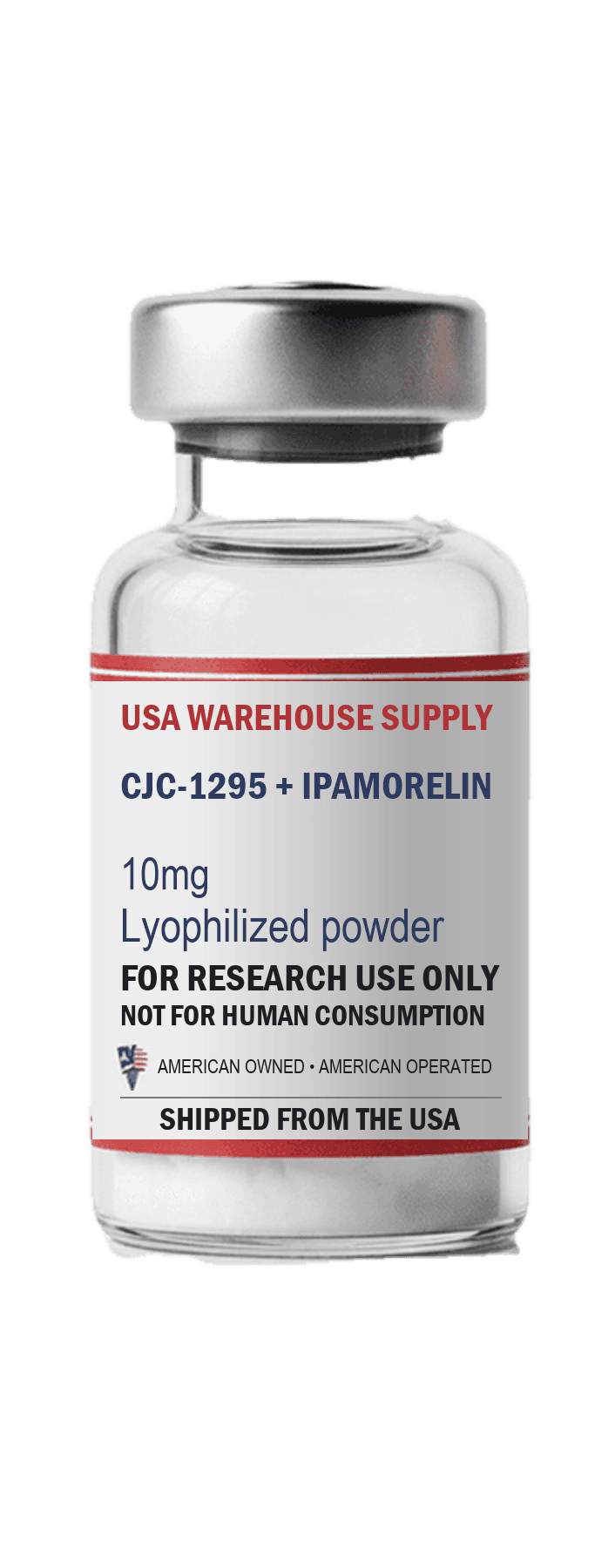
CJC-1295 + Ipamorelin
CJC-1295 + Ipamorelin: one 10mg vial combining a GHRH analog and a ghrelin-receptor (GHS-R1a) agonist. For laboratory research only.
What it is
CJC-1295 + Ipamorelin is a single 10mg vial that combines two peptides studied at different receptors of the somatotropic axis. CJC-1295 no DAC, also called Mod GRF 1-29, is a 29-residue analog of growth hormone-releasing hormone with no albumin-binding group. Ipamorelin, Aib-His-D-2-Nal-D-Phe-Lys-NH2, is a synthetic pentapeptide that acts on the ghrelin receptor, GHS-R1a.
In the 1998 paper that introduced ipamorelin, profiling with GHRP and GHRH antagonists placed its action at a GHRP-like receptor rather than the GHRH receptor. The two peptides therefore act at separate receptors, which is the reason labs pair a GHRH analog with a ghrelin-receptor ligand in receptor-pathway work. USA Warehouse Supply lists this blend as lyophilized powder for laboratory research only.
Storage
- Manufacturer data sheets list each solid peptide, CJC-1295 without DAC and ipamorelin, for storage at -20°C with stability of 4 years; published data are per peptide, not for the blend.
- The ipamorelin data sheet recommends against keeping an aqueous solution beyond the short term; published data are per peptide, not for the blend.
- A manufacturer's general peptide handling guide advises dividing peptide solutions into aliquots kept frozen below -15°C.
Cited research applications
Questions
What is the difference between CJC-1295 and ipamorelin?
CJC-1295 and ipamorelin are structurally unrelated peptides that act at different receptors of the somatotropic axis: CJC-1295 is a 29- or 30-residue analog of growth hormone-releasing hormone (GHRH 1-29) studied at the GHRH receptor, while ipamorelin is a five-residue ghrelin-receptor (GHS-R1a) agonist. CJC-1295 comes in two forms. With DAC, the 30-residue peptide (CAS 446262-90-4, molecular weight 3647.2 g/mol) carries a maleimidopropionamide group on its C-terminal lysine that binds serum albumin. Without DAC, also called Mod GRF 1-29, it is the 29-residue amidated sequence alone (CAS 863288-34-0, molecular weight 3367.9 g/mol); both forms have D-alanine at position 2. Ipamorelin (Aib-His-D-2-Nal-D-Phe-Lys-NH2, CAS 170851-70-4, molecular weight 711.9 g/mol) contains three non-proteinogenic residues and a C-terminal amide, so it has no standard one-letter sequence. Published work in cell and animal models concerns binding and signaling at the two receptors. USA Warehouse Supply lists ipamorelin and a no-DAC CJC-1295 with ipamorelin blend.
Which form of CJC-1295 is in the CJC-1295 + Ipamorelin vial?
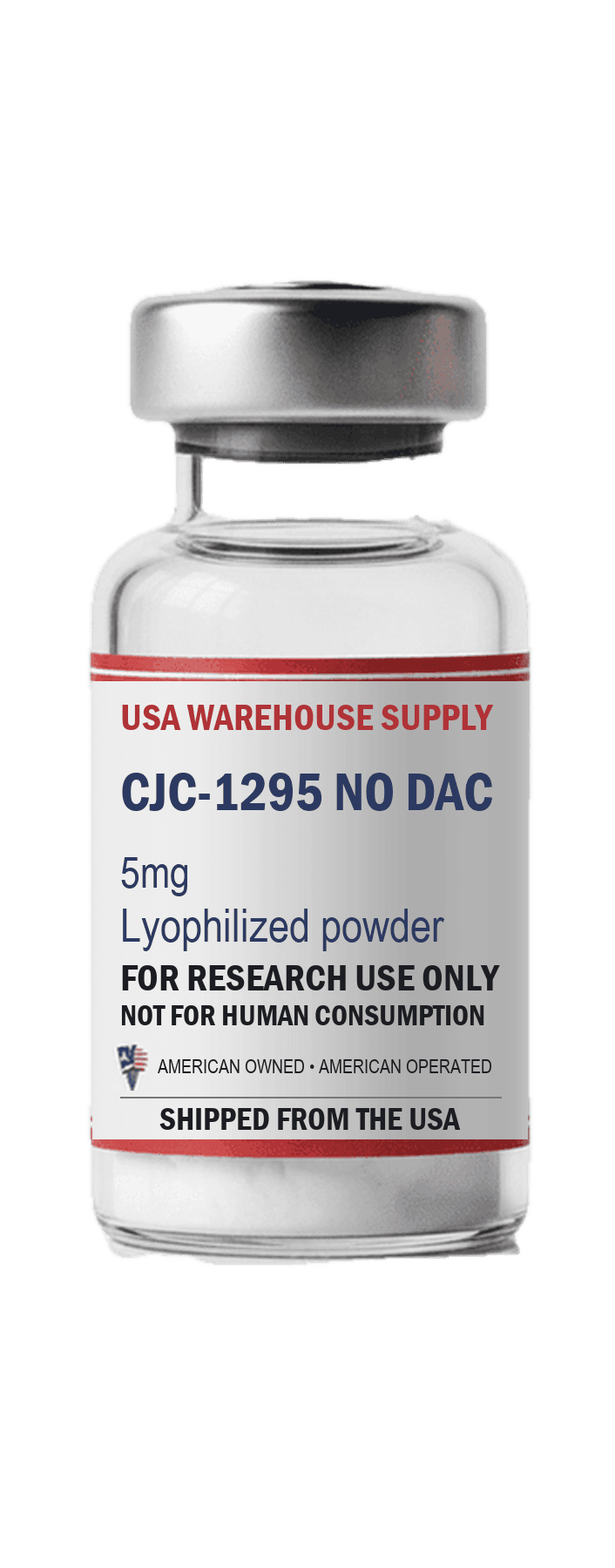
The CJC-1295 in this vial is the no-DAC form, also called Mod GRF 1-29 or Modified GRF (1-29): a 29-residue analog of growth hormone-releasing hormone with the substitutions D-Ala2, Gln8, Ala15 and Leu27 and no drug affinity complex. It is not CJC-1295 DAC, the longer peptide that carries an albumin-binding maleimidopropionyl group on an added lysine.
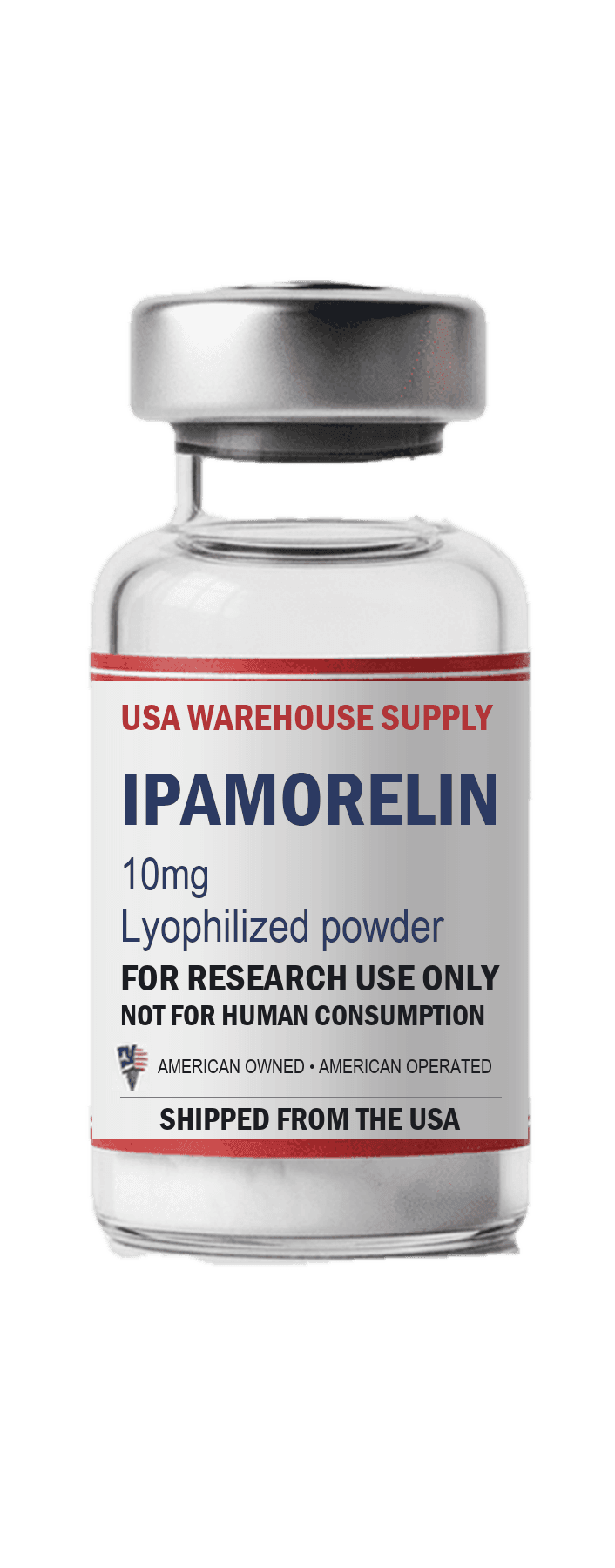
Both CJC-1295 forms are analogs of GRF(1-29) studied at the GHRH receptor. Ipamorelin, Aib-His-D-2-Nal-D-Phe-Lys-NH2, acts on a different receptor, the ghrelin receptor GHS-R1a, so the vial combines one ligand for each receptor. USA Warehouse Supply lists the blend as a single 10mg vial of lyophilized powder for laboratory research, alongside separate CJC-1295 DAC, CJC-1295 no DAC and ipamorelin vials.
Related compounds
For Research Use Only. Not for human or animal consumption. This product has not been evaluated by the Food and Drug Administration. Not intended to diagnose, treat, cure, or prevent any disease. CJC-1295 + Ipamorelin is sold strictly as a research chemical for in-vitro and pre-clinical laboratory investigation only.