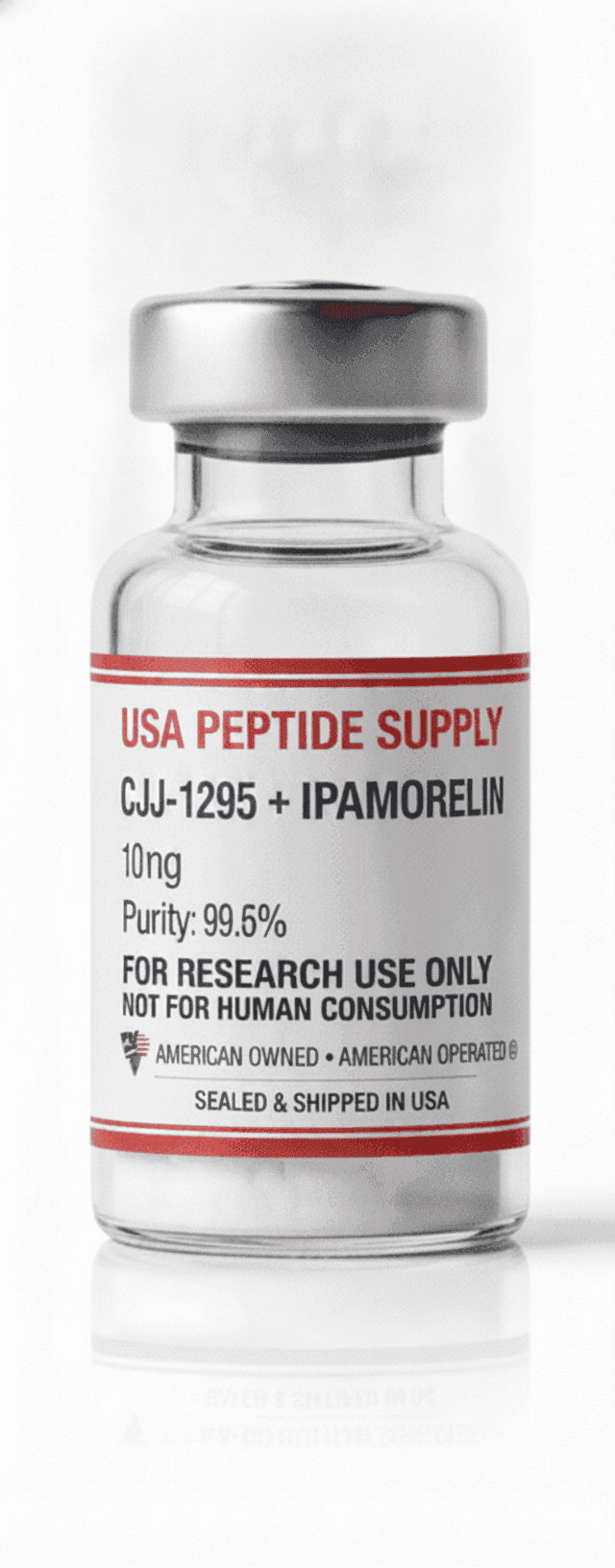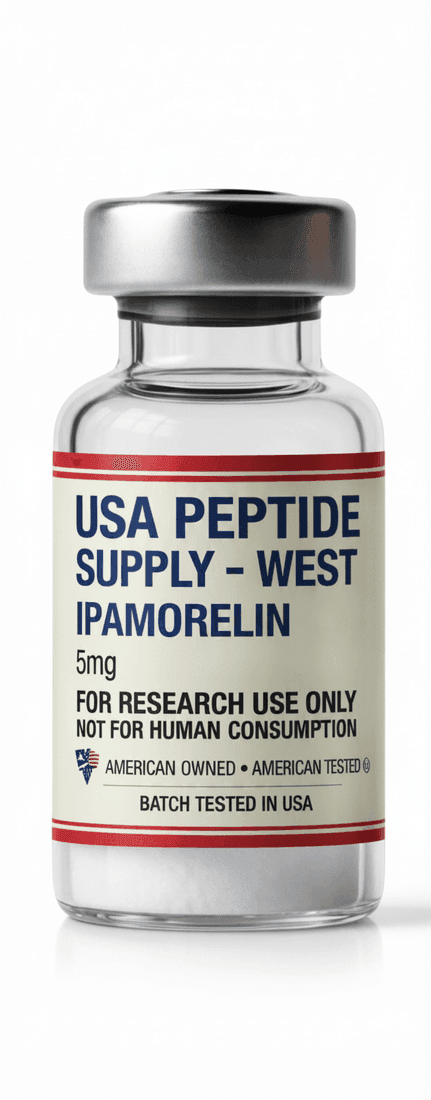
Ipamorelin
Ipamorelin is a synthetic pentapeptide and selective agonist of the ghrelin receptor (GHS-R1a). It is valued as a clean reference compound for pulsatile somatotropic-axis research with minimal off-target activity.
The cleanest selective GHS-R reference peptide for pulsatile-axis studies.
What it is
Ipamorelin (Aib-His-D-2-Nal-D-Phe-Lys-NH2) is a synthetic pentapeptide that selectively activates the ghrelin receptor (GHS-R1a) with minimal off-target activity at other pathways.
It is used as a reference secretagogue in pre-clinical models of GHS-R signaling and pulsatile somatotropic-axis research. For laboratory use only.
Reconstitution & storage
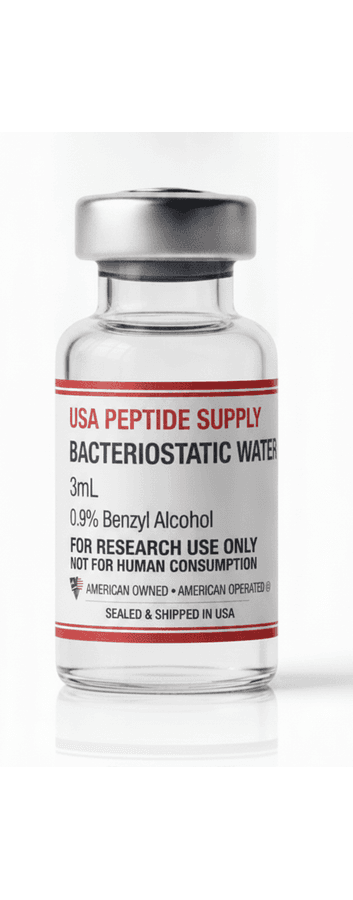
- Reconstitute with bacteriostatic water — add slowly down the vial wall and swirl gently; do not shake.
- Store lyophilized vials at -20°C; once reconstituted keep at 2–8°C and use within 16 weeks.
- Protect from light and avoid repeated freeze–thaw cycles.
Cited research applications
Questions
Compound identifiers & literature
Public database identifiers and a selection of peer-reviewed publications for Ipamorelin, provided so researchers can verify this compound independently. Each entry links to the primary source.
Selected literature
- [1]Raun K, Hansen BS, Johansen NL, Thøgersen H, Madsen K, Ankersen M, Andersen PH (1998). Ipamorelin, the first selective growth hormone secretagogue European Journal of Endocrinology.Original characterization of ipamorelin as a synthetic pentapeptide growth hormone secretagogue, reporting growth hormone release from primary rat pituitary cells in vitro and in anaesthetised rats and conscious swine with potency and efficacy similar to GHRP-6, and reporting that ipamorelin did not release ACTH or cortisol at levels significantly different from those observed after GHRH stimulation, at doses more than 200-fold above the ED50 for growth hormone release, whereas GHRP-6 and GHRP-2 did increase plasma ACTH and cortisol.in vitro and animal (primary rat pituitary cells in vitro; pentobarbital-anaesthetised rats; conscious swine)PMID 9849822DOI
- [2]Gobburu JV, Agersø H, Jusko WJ, Ynddal L (1999). Pharmacokinetic-pharmacodynamic modeling of ipamorelin, a growth hormone releasing peptide, in human volunteers Pharmaceutical Research.Pharmacokinetic-pharmacodynamic modeling study in healthy male volunteers given single 15-minute intravenous infusions of ipamorelin at five dose levels (4.21 to 140.45 nmol/kg), with eight subjects per dose level, reporting dose-proportional pharmacokinetics, a terminal half-life of approximately 2 hours, clearance of 0.078 L/h/kg, and a single episode of growth hormone release peaking near 0.67 hours followed by exponential decline. Single-dose pharmacology only; the study did not assess repeated administration, clinical efficacy, or long-term safety.human clinical trial (single-dose escalation in healthy male volunteers; eight subjects at each of five dose levels)PMID 10496658DOI
- [3]Johansen PB, Nowak J, Skjaerbaek C, Flyvbjerg A, Andreassen TT, Wilken M, Orskov H (1999). Ipamorelin, a new growth-hormone-releasing peptide, induces longitudinal bone growth in rats Growth Hormone & IGF Research.Fifteen-day study in adult female rats given subcutaneous ipamorelin at 0, 18, 90 or 450 micrograms per day, divided into three injections daily. Longitudinal bone growth rate at the proximal tibial metaphysis, measured by intravital tetracycline labelling, increased dose-dependently from 42 micrometres per day in the vehicle group to 44, 50 and 52 micrometres per day in the treatment groups, with a dose-dependent increase in body weight gain. Total IGF-I, IGF binding proteins, serum markers of bone formation and resorption, and pituitary growth hormone content were unchanged. The authors stated that any role in treating growth retardation in children would require future clinical studies.
- [4]Svensson J, Lall S, Dickson SL, Bengtsson BA, Rømer J, Ahnfelt-Rønne I, Ohlsson C, Jansson JO (2000). The GH secretagogues ipamorelin and GH-releasing peptide-6 increase bone mineral content in adult female rats Journal of Endocrinology.Twelve-week study in young adult female rats given ipamorelin (0.5 mg/kg per day), GH-releasing peptide-6 (0.5 mg/kg per day), growth hormone (3.5 mg/kg per day) or vehicle continuously by subcutaneous osmotic minipump. All treatments increased body weight and total tibial and vertebral bone mineral content by dual X-ray absorptiometry, but total bone mineral content corrected for the increase in body weight was unaffected. Peripheral quantitative computed tomography and Archimedes' principle measurements indicated the increases in cortical and total bone mineral content reflected increased bone dimensions, with volumetric bone mineral density unchanged.
- [5]Venkova K, Mann W, Nelson R, Greenwood-Van Meerveld B (2009). Efficacy of ipamorelin, a novel ghrelin mimetic, in a rodent model of postoperative ileus Journal of Pharmacology and Experimental Therapeutics.Study in a rat postoperative ileus model comparing intravenous bolus ipamorelin (0.01-1 mg/kg), GHRP-6 (20 micrograms/kg) and saline vehicle, given either as a single dose or as a two-day repetitive regimen of four doses daily at three-hour intervals. A single dose of ipamorelin (1 mg/kg) or GHRP-6 decreased time to first bowel movement but had no effect on cumulative fecal output, food intake or body weight gain at 48 hours; repetitive dosing of ipamorelin (0.1 or 1 mg/kg) increased cumulative fecal pellet output, food intake and body weight gain. The authors suggested postsurgical intravenous infusion might ameliorate postoperative ileus symptoms in patients; no human data were generated in this study.rodent (fasted male rats subjected to laparotomy with intestinal manipulation; strain not specified in the abstract)PMID 19289567DOI
These references are provided for scientific context only. They describe published research on this compound and are not evidence of safety or efficacy, not an endorsement of any use, and not medical advice. This product is supplied for laboratory research use only — not for human or animal consumption.
Related compounds
For Research Use Only. Not for human or animal consumption. This product has not been evaluated by the Food and Drug Administration. Not intended to diagnose, treat, cure, or prevent any disease. Ipamorelin is sold strictly as a research chemical for in-vitro and pre-clinical laboratory investigation only.