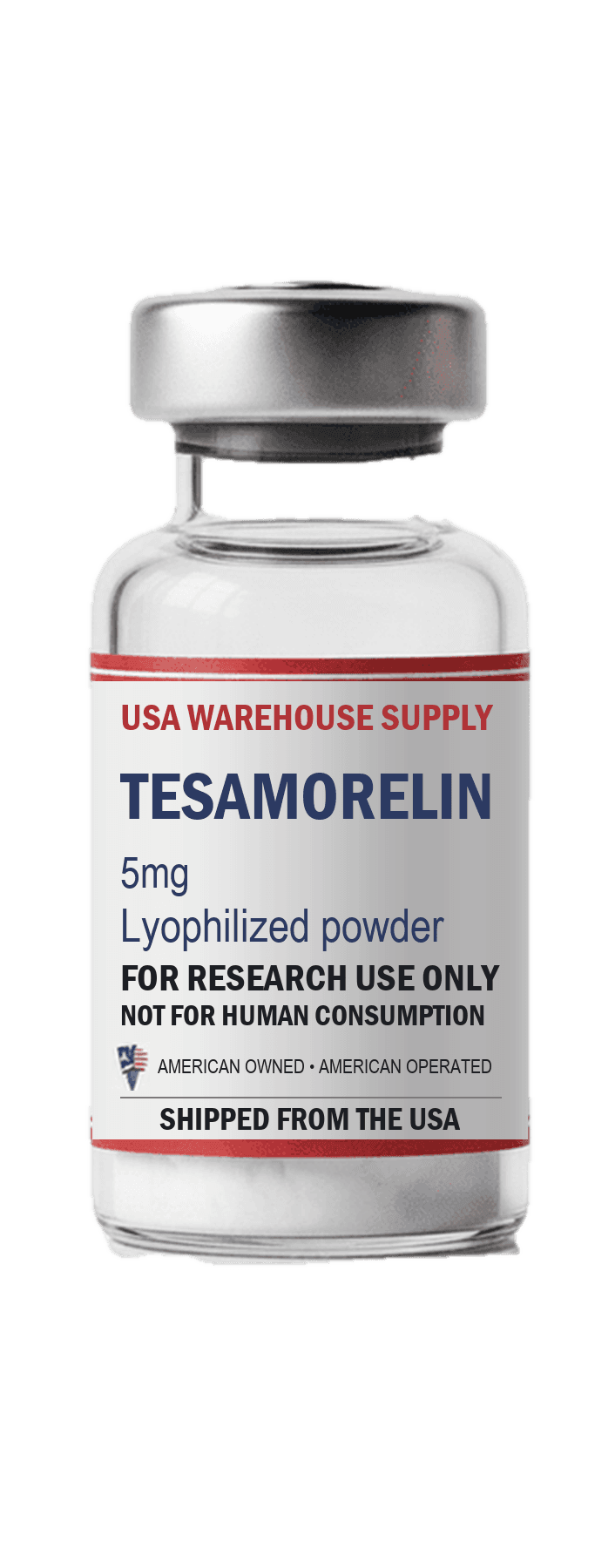
Tesamorelin
Tesamorelin (TH9507), a 44-residue GHRH analog with an N-terminal trans-3-hexenoyl group. 10mg lyophilized vial for laboratory research only.
What it is
Tesamorelin, also known by the code TH9507, is a synthetic analog of human growth hormone-releasing factor (hGRF 1-44). It keeps the native 44-residue sequence, ending in a C-terminal amide, and adds a trans-3-hexenoyl group to the N-terminal tyrosine. In non-clinical work that modification made the peptide resistant to dipeptidyl peptidase-4 and slowed its breakdown in rat, dog and human plasma in vitro. PubChem lists tesamorelin as CAS 218949-48-5, formula C221H366N72O67S, molecular weight about 5136 g/mol.
Non-clinical pharmacology of TH9507 was studied in rats, dogs and pigs. As a GHRH analog it is a research tool for the GHRH receptor and the somatotropic axis. Tesamorelin has also been evaluated in clinical trials (for example NCT02012556). USA Warehouse Supply lists tesamorelin as a 10mg vial of lyophilized powder for laboratory research only.
Storage
- A manufacturer data sheet lists solid tesamorelin for storage at -20°C, with stability of 4 years.
- Store as set out in the lyophilized-peptide storage note on the research library page.
Cited research applications
Questions
What is tesamorelin?
Tesamorelin is a synthetic 44-residue analog of human growth hormone-releasing hormone (GHRH 1-44) carrying a trans-3-hexenoyl group on its N-terminal tyrosine, a modification designed to resist cleavage by dipeptidyl peptidase-4. The amino-acid sequence is otherwise that of the native hormone, YADAIFTNSYRKVLGQLSARKLLQDIMSRQQGESNQERGARARL. Molecular formula C221H366N72O67S, molecular weight 5135.9 g/mol (free base; PubChem CID 16137828 computes 5136), CAS 218949-48-5. Synonyms: TH9507. Published work in cell and animal models concerns binding at the GHRH receptor on pituitary somatotrophs. That receptor also separates it from ipamorelin: tesamorelin is a GHRH-receptor ligand built on the full hormone sequence, while ipamorelin is a five-residue ghrelin-receptor (GHS-R1a) agonist with non-proteinogenic residues, so the two engage the somatotropic axis through different receptors. USA Warehouse Supply lists tesamorelin as a lyophilized powder for laboratory research.
How does tesamorelin differ from CJC-1295?
Tesamorelin and CJC-1295 are both analogs of growth hormone-releasing hormone, but they are built differently. Tesamorelin keeps the full 44-residue human GHRH sequence and adds a trans-3-hexenoyl group at the N-terminal tyrosine. CJC-1295 starts from the shorter GRF(1-29) fragment and changes four residues: D-Ala2, Gln8, Ala15 and Leu27.
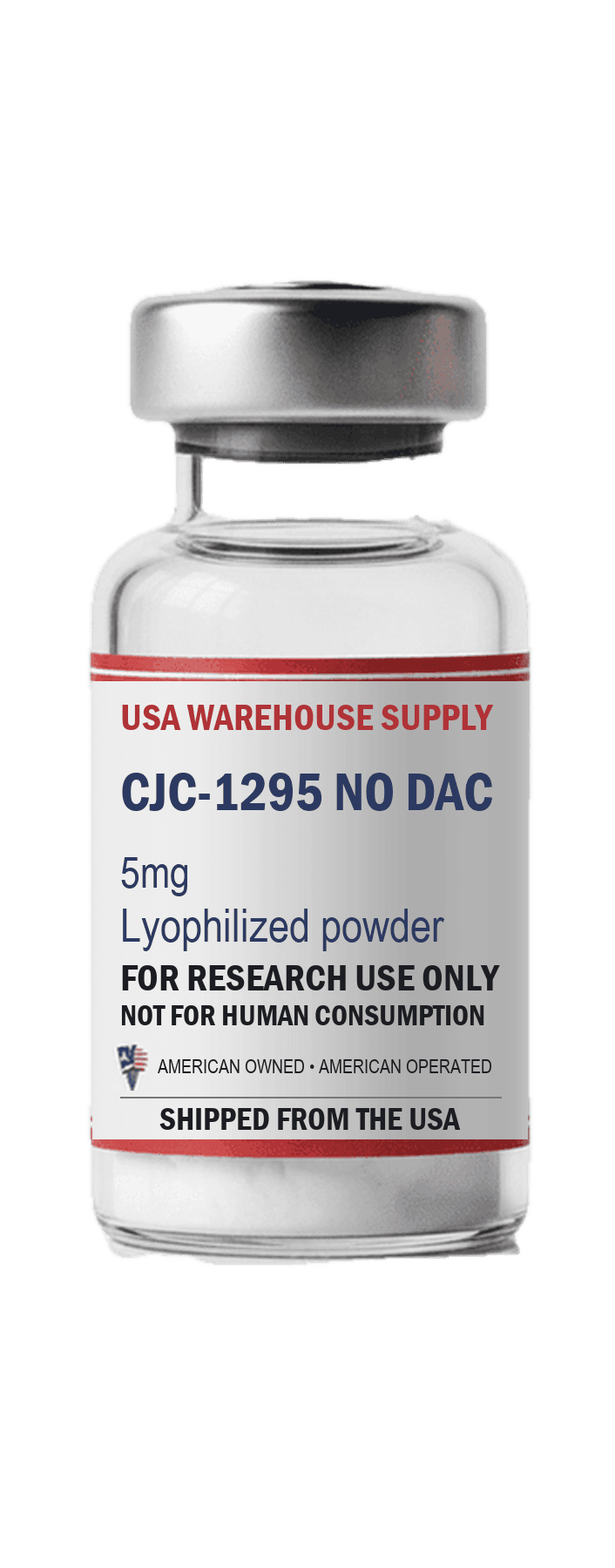
Both designs change the N-terminal end, where dipeptidyl peptidase-4 inactivates native GRF by cutting the Ala2-Asp3 bond. Tesamorelin leaves that bond in place and adds an N-terminal acyl group, which made it resistant to the enzyme in non-clinical work. CJC-1295 replaces the residue at position 2 with D-alanine. CJC-1295 DAC also adds a lysine with a maleimidopropionyl group that binds serum albumin, while CJC-1295 no DAC (Mod GRF 1-29) has no such group. By PubChem data, tesamorelin weighs about 5136 g/mol, CJC-1295 DAC 3647.2 and CJC-1295 no DAC 3367.9. All three are studied at the GHRH receptor. USA Warehouse Supply lists tesamorelin and both CJC-1295 forms as lyophilized powder for laboratory research.
Compound identifiers & literature
Public database identifiers and a selection of peer-reviewed publications for Tesamorelin, provided so researchers can verify this compound independently. Each entry links to the primary source.
Selected literature
- [1]Ferdinandi ES, Brazeau P, High K, Procter B, Fennell S, Dubreuil P (2007). Non-clinical pharmacology and safety evaluation of TH9507, a human growth hormone-releasing factor analogue Basic & Clinical Pharmacology & Toxicology.Preclinical pharmacology and safety package for TH9507 (tesamorelin): studies in pigs, subchronic toxicity studies of up to four months in Sprague-Dawley rats and in dogs, and in vitro peptide degradation in rat, dog and human plasma.rodent (rat), with additional dog and pig in vivo work and in vitro plasma degradation assaysPMID 17214611DOI
These references are provided for scientific context only. They describe published research on this compound and are not evidence of safety or efficacy, not an endorsement of any use, and not medical advice. This product is supplied for laboratory research use only — not for human or animal consumption.
Related compounds
For Research Use Only. Not for human or animal consumption. This product has not been evaluated by the Food and Drug Administration. Not intended to diagnose, treat, cure, or prevent any disease. Tesamorelin is sold strictly as a research chemical for in-vitro and pre-clinical laboratory investigation only.