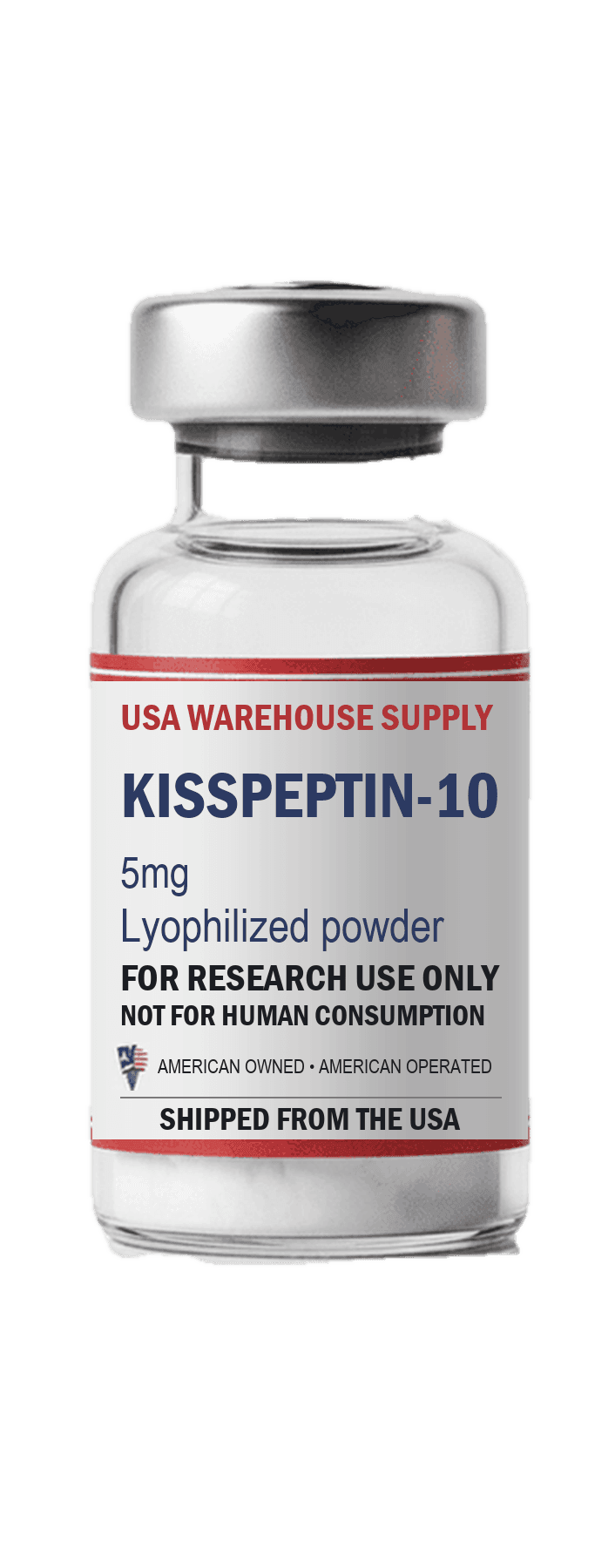
Kisspeptin-10
Kisspeptin-10 is the synthetic decapeptide Tyr-Asn-Trp-Asn-Ser-Phe-Gly-Leu-Arg-Phe-NH2, the C-terminal fragment shared by the kisspeptins encoded by the KISS1 gene. It is a reference agonist in KISS1R (GPR54) receptor signaling and hypothalamic-pituitary-gonadal axis research.
A defined KISS1R agonist for GPR54 signaling and HPG-axis studies.
What it is
Kisspeptin-10, also listed as metastin 45-54 or KP-10, is a ten-residue peptide with an amidated C-terminus, matching the RF-amide ending of the longer kisspeptins processed from the KISS1 gene product. It binds and activates KISS1R, the G protein-coupled receptor first described as GPR54.
It serves as a reference agonist in KISS1R binding and signaling assays in cell lines, and in pre-clinical models of hypothalamic GnRH-neuron and pituitary-axis signaling. It is not interchangeable with kisspeptin-54, a longer peptide with its own literature. Supplied for laboratory use only.
Storage
- Store lyophilized vials at -20°C and follow the storage window on the label.
- Protect from light and avoid repeated freeze-thaw cycles.
Cited research applications
Questions
Compound identifiers & literature
Public database identifiers and a selection of peer-reviewed publications for Kisspeptin-10 (metastin 45-54, KP-10), provided so researchers can verify this compound independently. Each entry links to the primary source.
Selected literature
- [1]Kotani M, Detheux M, Vandenbogaerde A, Communi D, Vanderwinden JM, Le Poul E, Brézillon S, Tyldesley R, Suarez-Huerta N, Vandeput F, Blanpain C, Schiffmann SN, Vassart G, Parmentier M (2001). The metastasis suppressor gene KiSS-1 encodes kisspeptins, the natural ligands of the orphan G protein-coupled receptor GPR54 The Journal of biological chemistry 276(37):34631-6.Identified 54-, 14- and 13-residue peptides with a common RF-amide C terminus, derived from the KiSS-1 gene product and named kisspeptins, as agonists of the orphan receptor GPR54. In CHO-K1 cells expressing rat or human GPR54 they bound with low nanomolar affinity and stimulated PIP2 hydrolysis, calcium mobilization, arachidonic acid release and ERK1/2 and p38 MAP kinase phosphorylation; oxytocin secretion was also examined in rats.
- [2]Navarro VM, Castellano JM, Fernández-Fernández R, Barreiro ML, Roa J, Sanchez-Criado JE, Aguilar E, Dieguez C, Pinilla L, Tena-Sempere M (2004). Developmental and hormonally regulated messenger ribonucleic acid expression of KiSS-1 and its putative receptor, GPR54, in rat hypothalamus and potent luteinizing hormone-releasing activity of KiSS-1 peptide Endocrinology 145(10):4565-74.Mapped KiSS-1 and GPR54 mRNA expression in the rat hypothalamus across postnatal development, the estrous cycle, gonadectomy with and without sex steroid replacement, and neonatal estrogen imprinting, and examined serum luteinizing hormone after central delivery of a KiSS-1 peptide in prepubertal and adult rats.rodent (rat hypothalamus; male and female rats across postnatal development, the estrous cycle and after gonadectomy)PMID 15242985DOI
- [3]Navarro VM, Castellano JM, Fernández-Fernández R, Tovar S, Roa J, Mayen A, Nogueiras R, Vazquez MJ, Barreiro ML, Magni P, Aguilar E, Dieguez C, Pinilla L, Tena-Sempere M (2005). Characterization of the potent luteinizing hormone-releasing activity of KiSS-1 peptide, the natural ligand of GPR54 Endocrinology 146(1):156-63.Characterised the effect of a KiSS-1 peptide on luteinizing hormone secretion in rats under several experimental settings, including hypothalamic LHRH mRNA measurements, a direct pituitary preparation, and blockade of excitatory amino acid and nitric oxide pathways.
These references are provided for scientific context only. They describe published research on this compound and are not evidence of safety or efficacy, not an endorsement of any use, and not medical advice. This product is supplied for laboratory research use only — not for human or animal consumption.
Related compounds
For Research Use Only. Not for human or animal consumption. This product has not been evaluated by the Food and Drug Administration. Not intended to diagnose, treat, cure, or prevent any disease. Kisspeptin-10 is sold strictly as a research chemical for in-vitro and pre-clinical laboratory investigation only.