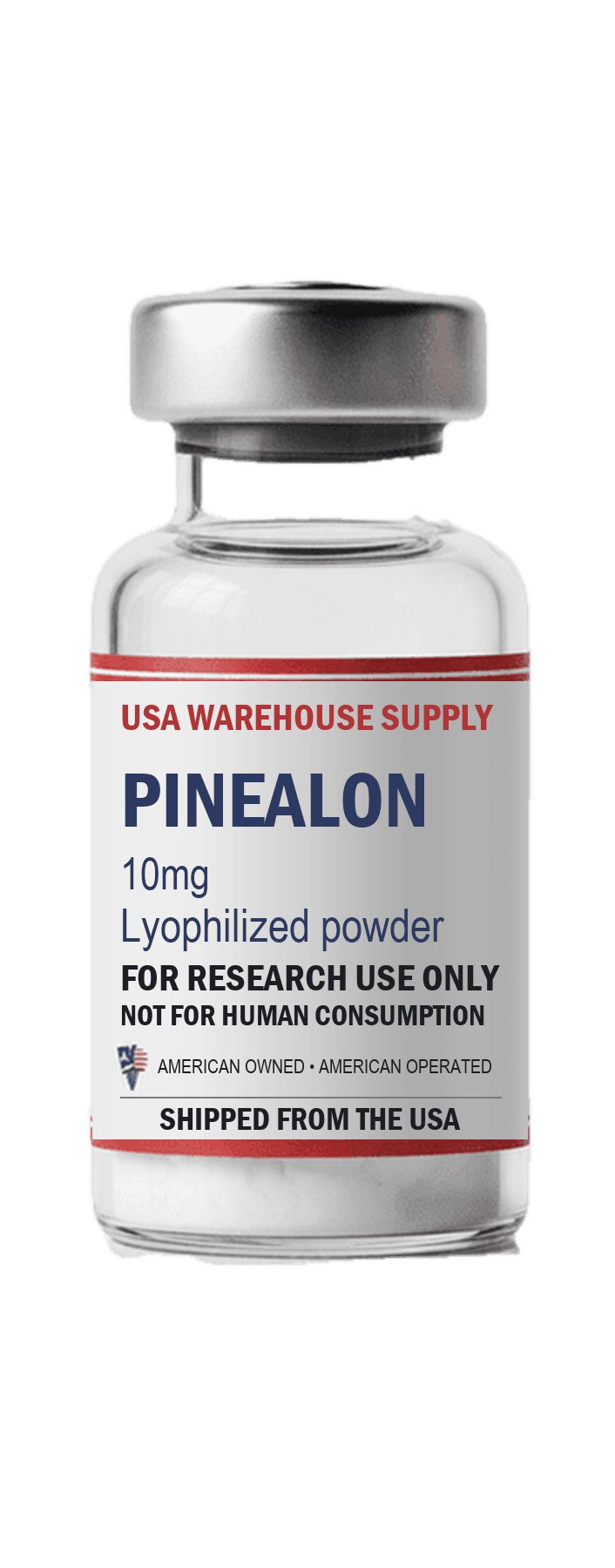
Pinealon
Pinealon is the synthetic tripeptide Glu-Asp-Arg (EDR), one of the short peptides characterized by Khavinson's group in St. Petersburg. It is a reference compound in short-peptide gene-expression and neuronal cell-culture research.
A three-residue bioregulator peptide for short-peptide signaling studies.
What it is
Pinealon is H-Glu-Asp-Arg-OH: three L-amino acids with a free amine at one end and a free acid at the other. Two residues are acidic and the third, arginine, carries a guanidino group. Its developers group it with the ultrashort peptide bioregulators, two to four residues long.
Most published work comes from cell cultures and rodent models, including oxidative-stress assays in neuronal cells and studies of how short peptides affect gene expression. Supplied strictly for laboratory research.
Storage
- Store lyophilized vials at -20°C and follow the storage window on the label.
- Protect from light and avoid repeated freeze-thaw cycles.
Cited research applications
Questions
Compound identifiers & literature
Public database identifiers and a selection of peer-reviewed publications for Pinealon (Glu-Asp-Arg, EDR), provided so researchers can verify this compound independently. Each entry links to the primary source.
Selected literature
- [1]Fedoreyeva LI, Kireev II, Khavinson VKh, Vanyushin BF (2011). Penetration of short fluorescence-labeled peptides into the nucleus in HeLa cells and in vitro specific interaction of the peptides with deoxyribooligonucleotides and DNA Biochemistry. Biokhimiia 76(11):1210-9.Fluorescein-labeled short peptides, including pinealon (Glu-Asp-Arg), epithalon and testagen, were followed into the cytoplasm, nucleus and nucleolus of HeLa cells. Fluorescence-quenching (Stern-Volmer) measurements with labeled single- and double-stranded deoxyribooligonucleotides and DNA-ethidium bromide complexes were used to compare how each peptide interacts with different nucleotide sequences and cytosine methylation states.
- [2]Silanteva IA, Komolkin AV, Morozova EA, Vorontsov-Velyaminov PN, Kasyanenko NA (2019). Role of Mono- and Divalent Ions in Peptide Glu-Asp-Arg-DNA Interaction The journal of physical chemistry. B 123(9):1896-1902.Studied the interaction of the peptide Glu-Asp-Arg (EDR) with DNA by spectral, NMR and viscometry methods and molecular dynamics simulation. EDR was found to partly enter the DNA major groove, affecting guanine N7 and O6 atoms, and Mg2+ ions strengthened the interaction by screening the phosphate charges.biophysical (spectroscopy, NMR, viscometry and molecular dynamics; no biological model)PMID 30762356DOI
- [3]Khavinson VKh, Linkova NS, Chalisova NI, Dudkov AV, Koncevaya EA (2011). Effect of short peptides on expression of signaling molecules in organotypic pineal cell culture Bulletin of experimental biology and medicine 152(1):138-41.Compared short peptides, including Glu-Asp-Arg, Ala-Glu-Asp-Gly, Lys-Glu-Asp and Lys-Glu, in organotypic rat pineal gland culture by measuring expression of the proliferation marker Ki-67, the apoptosis marker AIF and CGRP. Glu-Asp-Arg did not change AIF expression.
- [4]Arutjunyan A, Kozina L, Stvolinskiy S, Bulygina Y, Mashkina A, Khavinson V (2012). Pinealon protects the rat offspring from prenatal hyperhomocysteinemia International journal of clinical and experimental medicine 5(2):179-85.Studied pinealon (Glu-Asp-Arg) in the offspring of pregnant rats given a methionine-loaded diet to induce hyperhomocysteinemia, using spatial-orientation and learning tasks and, in cerebellar neurons isolated from the offspring, reactive oxygen species accumulation and necrotic cell counts.rodent (offspring of rats with diet-induced prenatal hyperhomocysteinemia; isolated cerebellar neurons)PMID 22567179
These references are provided for scientific context only. They describe published research on this compound and are not evidence of safety or efficacy, not an endorsement of any use, and not medical advice. This product is supplied for laboratory research use only — not for human or animal consumption.
Related compounds
For Research Use Only. Not for human or animal consumption. This product has not been evaluated by the Food and Drug Administration. Not intended to diagnose, treat, cure, or prevent any disease. Pinealon is sold strictly as a research chemical for in-vitro and pre-clinical laboratory investigation only.